

Wealth Flash
The Knowledge Share
Why China is Making Recycling Strategic
China’s policies are far from perfect, but it does not set strategic priorities lightly. Beijing thinks years, sometimes decades ahead. The Iran oil shock has already proved the wisdom of China’s shift toward security, especially energy security, several years ago – leaving many countries scrambling to catch up in 2026. Will recycling become the next big thing? Read on for our takes.
CIO Summary
- China is turning recycling into a strategic resource-security tool. Recycling is shifting from saving the environment to securing critical materials, particularly as trade tensions and geopolitical uncertainty increase globally.
- Recycling adds a new dimension to China’s structural manufacturing advantage. Beijing’s edge lies in the depth and integration of its industrial ecosystem, from raw materials and processing to manufacturing, distribution and now recycling. Recycling of critical materials should increasingly become a measure of a country’s manufacturing (or even economic) strength.
- Battery recycling reinforces our CATL investment thesis. Recycling is unlikely to fundamentally change CATL’s business model, but it strengthens its vertically integrated ecosystem, potentially reducing vulnerability to raw-material price spikes and supply constraints. The near-term earnings impact may be modest, but recycling could support a long-term valuation multiple expansion.
The Economist recently featured an article titled “China is turning trash into treasure on a vast scale”, highlighting how China is turning recycling into a strategic initiative – which is worth noting. We’d like to share a few key takeaways from this piece. Hope you find them useful.
- Recycling is becoming a strategic tool for resource security. China is shifting the focus of recycling from pollution control toward securing the aluminium, copper, battery metals and rare earths needed for advanced manufacturing. Despite dominating global refining capacity in many critical materials, China still relies heavily on imports for the underlying ores – which is viewed as a key vulnerability.
- China is rapidly scaling its circular economy. Beijing aims for recycling to supply 510mn tonnes of industrial materials annually by 2030, about one-third above current levels. The opportunity is being reinforced by a coming wave of clean-tech waste, including 0.5mn tonnes of wind-turbine waste, 1mn tonnes of EV batteries and 1.5-2mn tonnes of solar panels annually by 2030.
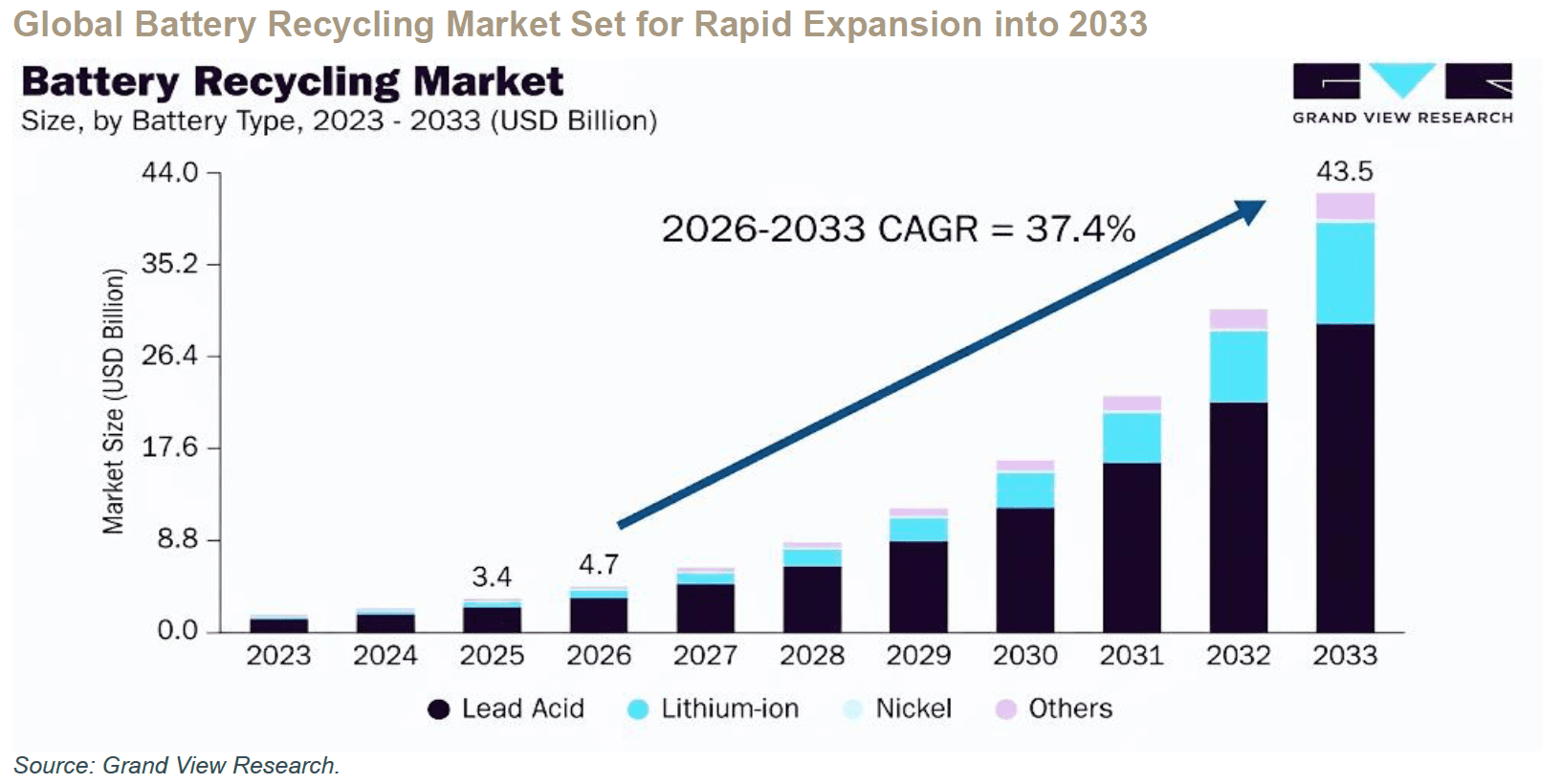
- EV batteries are the biggest opportunity, with China already in the lead. China has built 85% of global battery-recycling capacity, with CATL's subsidiary Brunp recognized as the world’s largest battery recycler. Retired batteries can be converted into “black mass” to recover lithium, cobalt and nickel, which the IEA estimates could eventually supply 20-30% of global battery-metal demand by 2050.
- The state is building an ecosystem to reinforce the recycling advantage. Beijing established China Resources Recycling Group in 2024 to coordinate recycling, while battery and EV makers are required to track products through digital IDs and take responsibility for battery recycling. China is also selectively reopening imports of valuable recycled materials such as scrap copper, aluminium and black mass to help feed its recycling industry.
- The potential is large, but execution remains challenging. Collection is fragmented, recycling capacity is underutilised, and recovering some materials remains difficult or uneconomical. Rare-earth recycling, for example, already accounts for 10% of China's rare-earth supply, but remains considerably more costly than extraction from raw materials.
Our Take
- Investors should pay attention to China’s strategic priorities, even if they don’t invest directly in China. Past strategic initiatives, from manufacturing upgrades to technology innovations, have had far-reaching implications for global trade, economies and financial markets. Simply too big to ignore. We’ve also made this point in our recent Wealth Flash on China’s strategic sights on skills development, a separate topic.
- Resource security is indeed a national-security issue. The article notes that China's latest circular-economy plan links recycling to resource security, which is increasingly a national security priority. This is especially true amid rising trade tensions and geopolitical uncertainty, as many critical materials are essential not only for commercial products but also for defense purposes.
- The article reinforces our view that China’s manufacturing advantage is structural (not cyclical) and sustainable. The edge is essentially about the depth and integration of an entire ecosystem, spanning raw materials, processing, components, manufacturing, distribution and now recycling. Recycling is new here and not something we typically associate with manufacturing competitiveness. Yet this is something that should increasingly become a key metric for a country’s manufacturing (or even economic) strength.
- The article also reinforces our Core Recommendation on CATL (300750.CH / 3750.HK). We’ve long argued that CATL’s moat extends beyond its global scale to vertical integration and technology leadership. This vertical integration covers raw materials, components, battery systems, localized manufacturing and recycling. Granted, recycling (including Brunp) accounted for only 5% of CATL’s group revenue in 2025. However, it will likely contribute to a growing share of profits and prove its strategic value when raw material prices spike or supply becomes constrained. Will recycling fundamentally change CATL’s business model? Unlikely. Will this make CATL more resilient to external shocks? You bet. In conclusion, the near-term earnings impact may be modest, but recycling could support a long-term valuation multiple expansion – as investors increasingly view CATL’s moat as more durable.
China’s policies are far from perfect, but it does not set strategic priorities lightly. Beijing thinks years, sometimes decades ahead. The Iran oil shock has already proved the wisdom of China’s shift toward security, especially energy security, several years ago – leaving many countries scrambling to catch up in 2026. Will recycling become the next big thing? Read on for our takes.
CIO Summary
- China is turning recycling into a strategic resource-security tool. Recycling is shifting from saving the environment to securing critical materials, particularly as trade tensions and geopolitical uncertainty increase globally.
- Recycling adds a new dimension to China’s structural manufacturing advantage. Beijing’s edge lies in the depth and integration of its industrial ecosystem, from raw materials and processing to manufacturing, distribution and now recycling. Recycling of critical materials should increasingly become a measure of a country’s manufacturing (or even economic) strength.
- Battery recycling reinforces our CATL investment thesis. Recycling is unlikely to fundamentally change CATL’s business model, but it strengthens its vertically integrated ecosystem, potentially reducing vulnerability to raw-material price spikes and supply constraints. The near-term earnings impact may be modest, but recycling could support a long-term valuation multiple expansion.
The Economist recently featured an article titled “China is turning trash into treasure on a vast scale”, highlighting how China is turning recycling into a strategic initiative – which is worth noting. We’d like to share a few key takeaways from this piece. Hope you find them useful.
- Recycling is becoming a strategic tool for resource security. China is shifting the focus of recycling from pollution control toward securing the aluminium, copper, battery metals and rare earths needed for advanced manufacturing. Despite dominating global refining capacity in many critical materials, China still relies heavily on imports for the underlying ores – which is viewed as a key vulnerability.
- China is rapidly scaling its circular economy. Beijing aims for recycling to supply 510mn tonnes of industrial materials annually by 2030, about one-third above current levels. The opportunity is being reinforced by a coming wave of clean-tech waste, including 0.5mn tonnes of wind-turbine waste, 1mn tonnes of EV batteries and 1.5-2mn tonnes of solar panels annually by 2030.
- EV batteries are the biggest opportunity, with China already in the lead. China has built 85% of global battery-recycling capacity, with CATL's subsidiary Brunp recognized as the world’s largest battery recycler. Retired batteries can be converted into “black mass” to recover lithium, cobalt and nickel, which the IEA estimates could eventually supply 20-30% of global battery-metal demand by 2050.
- The state is building an ecosystem to reinforce the recycling advantage. Beijing established China Resources Recycling Group in 2024 to coordinate recycling, while battery and EV makers are required to track products through digital IDs and take responsibility for battery recycling. China is also selectively reopening imports of valuable recycled materials such as scrap copper, aluminium and black mass to help feed its recycling industry.
- The potential is large, but execution remains challenging. Collection is fragmented, recycling capacity is underutilised, and recovering some materials remains difficult or uneconomical. Rare-earth recycling, for example, already accounts for 10% of China's rare-earth supply, but remains considerably more costly than extraction from raw materials.
Our Take
- Investors should pay attention to China’s strategic priorities, even if they don’t invest directly in China. Past strategic initiatives, from manufacturing upgrades to technology innovations, have had far-reaching implications for global trade, economies and financial markets. Simply too big to ignore. We’ve also made this point in our recent Wealth Flash on China’s strategic sights on skills development, a separate topic.
- Resource security is indeed a national-security issue. The article notes that China's latest circular-economy plan links recycling to resource security, which is increasingly a national security priority. This is especially true amid rising trade tensions and geopolitical uncertainty, as many critical materials are essential not only for commercial products but also for defense purposes.
- The article reinforces our view that China’s manufacturing advantage is structural (not cyclical) and sustainable. The edge is essentially about the depth and integration of an entire ecosystem, spanning raw materials, processing, components, manufacturing, distribution and now recycling. Recycling is new here and not something we typically associate with manufacturing competitiveness. Yet this is something that should increasingly become a key metric for a country’s manufacturing (or even economic) strength.
- The article also reinforces our Core Recommendation on CATL (300750.CH / 3750.HK). We’ve long argued that CATL’s moat extends beyond its global scale to vertical integration and technology leadership. This vertical integration covers raw materials, components, battery systems, localized manufacturing and recycling. Granted, recycling (including Brunp) accounted for only 5% of CATL’s group revenue in 2025. However, it will likely contribute to a growing share of profits and prove its strategic value when raw material prices spike or supply becomes constrained. Will recycling fundamentally change CATL’s business model? Unlikely. Will this make CATL more resilient to external shocks? You bet. In conclusion, the near-term earnings impact may be modest, but recycling could support a long-term valuation multiple expansion – as investors increasingly view CATL’s moat as more durable.
Disclosures and disclaimers
This report is provided subject to, and must be read together with, the full Disclosures / Disclaimers available at this link, which are incorporated by reference into this report. In particular, this report is intended for general circulation and informational purposes only and does not constitute personal investment advice or a recommendation to buy or sell any investment product or security. You should independently evaluate the information and, where necessary, seek advice from a qualified financial adviser regarding the suitability of any investment. Analyst certifications required under applicable regulations, including SEC Regulation AC (where relevant), are included in this report. By accessing, receiving or using this report, you acknowledge that you have read, understood and agreed to be bound by the Disclosures / Disclaimers, as may be amended, supplemented or updated from time to time.


