

Strategy
Strategy: AI Export Curbs: Near-term Noise, Long-term Opportunity
Analyst
Analyst
Sirithat Prasertwuti
Analyst
Panjarat Thaweesriprasert
Investment Highlights
- We expect limited impact on Thailand data centre investments (electronics, utilities, industrial estates and construction), as the restrictions could potentially delay projects rather than lead to cancellations.
- Utilities face limited earnings risks, while industrial estates may see delays in land sales and transfers. Construction projects remain largely unaffected, while electronics stocks could face short-term sentiment pressure despite limited fundamental impact.
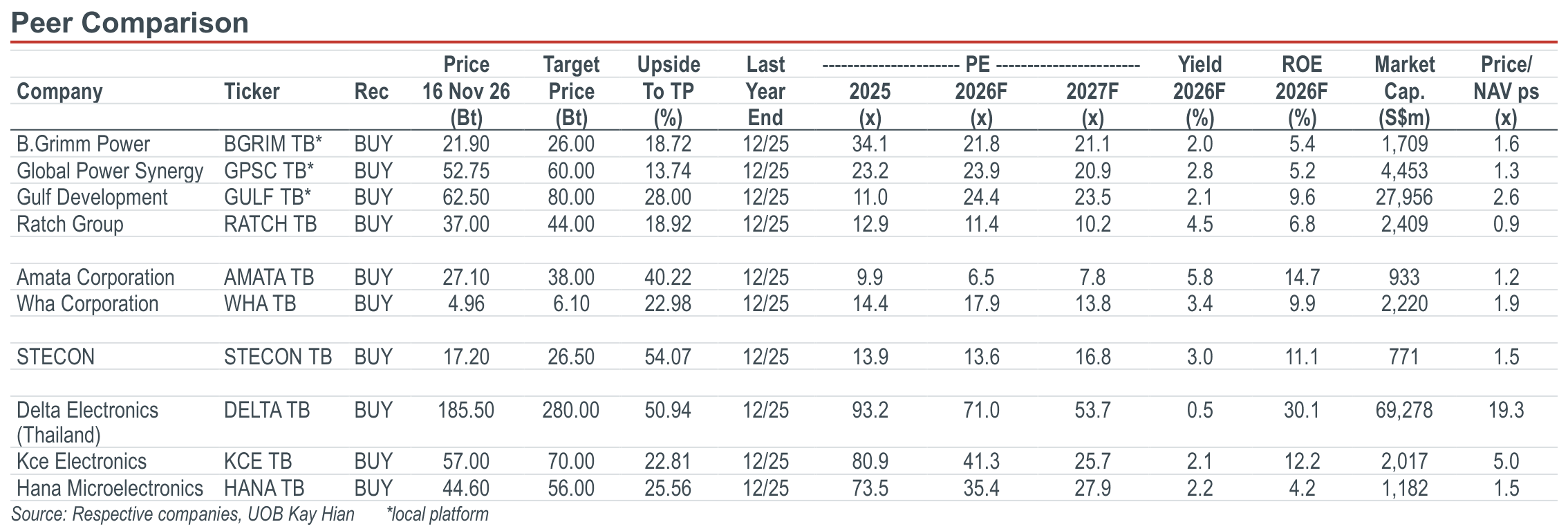
- We recommend accumulating fundamentally strong stocks, particularly GULF, WHA, STECON, DELTA and HANA.
Analysis
- New US restrictions raise concerns over data centre investments. The US has introduced new restrictions on advanced AI chip exports and access to AI computing services from overseas data centres. The measures aim to prevent Chinese companies from using data centres outside China to bypass US export controls. Thailand is among five countries facing additional licensing requirements, alongside Malaysia, Singapore, Indonesia and Brazil.
- The impact depends on the type of data centre business. We divide data centres into three categories: a) Traditional data centres (low risk): Mainly serve banks, businesses and cloud storage providers. They generally use CPUs, memory and storage systems rather than advanced AI chips; b) Colocation (low to moderate risk): Operators provide space, electricity and cooling, while customers install their own servers. The impact depends on whether customers use restricted AI chips; and c) AI computing (higher risk): These businesses use advanced GPUs for AI training and other AI applications. They face greater restrictions, particularly when providing computing services to Chinese customers. US hyperscaler may qualify for certain exemptions.
- Limited impact on data centre investments and related sectors. We expect the new US restrictions to delay rather than cancel data centre projects. Thailand’s BOI has approved 42 projects with 3,400MW of IT load, equivalent to 3.7-4.3GW of potential electricity demand. Chinese investors account for 24% of projects, but not all require advanced AI chips. Utilities should see minimal earnings impact, while industrial estates may face delays in land sales and transfers. Construction projects remain largely unaffected. Electronics stocks may face short-term sentiment pressure, but fundamental risks appear limited, particularly for DELTA and HANA.
Investment Highlights
- We expect limited impact on Thailand data centre investments (electronics, utilities, industrial estates and construction), as the restrictions could potentially delay projects rather than lead to cancellations.
- Utilities face limited earnings risks, while industrial estates may see delays in land sales and transfers. Construction projects remain largely unaffected, while electronics stocks could face short-term sentiment pressure despite limited fundamental impact.
- We recommend accumulating fundamentally strong stocks, particularly GULF, WHA, STECON, DELTA and HANA.
Analysis
- New US restrictions raise concerns over data centre investments. The US has introduced new restrictions on advanced AI chip exports and access to AI computing services from overseas data centres. The measures aim to prevent Chinese companies from using data centres outside China to bypass US export controls. Thailand is among five countries facing additional licensing requirements, alongside Malaysia, Singapore, Indonesia and Brazil.
- The impact depends on the type of data centre business. We divide data centres into three categories: a) Traditional data centres (low risk): Mainly serve banks, businesses and cloud storage providers. They generally use CPUs, memory and storage systems rather than advanced AI chips; b) Colocation (low to moderate risk): Operators provide space, electricity and cooling, while customers install their own servers. The impact depends on whether customers use restricted AI chips; and c) AI computing (higher risk): These businesses use advanced GPUs for AI training and other AI applications. They face greater restrictions, particularly when providing computing services to Chinese customers. US hyperscaler may qualify for certain exemptions.
- Limited impact on data centre investments and related sectors. We expect the new US restrictions to delay rather than cancel data centre projects. Thailand’s BOI has approved 42 projects with 3,400MW of IT load, equivalent to 3.7-4.3GW of potential electricity demand. Chinese investors account for 24% of projects, but not all require advanced AI chips. Utilities should see minimal earnings impact, while industrial estates may face delays in land sales and transfers. Construction projects remain largely unaffected. Electronics stocks may face short-term sentiment pressure, but fundamental risks appear limited, particularly for DELTA and HANA.
Analyst
Analyst
Sirithat Prasertwuti
Analyst
Panjarat Thaweesriprasert
IMPORTANT NOTICE - DISCLOSURES AND DISCLAIMERS
This report is provided subject to, and must be read together with, the full Disclosures / Disclaimers available at this link, which are incorporated by reference into this report. In particular, this report is intended for general circulation and informational purposes only and does not constitute personal investment advice or a recommendation to buy or sell any investment product or security. You should independently evaluate the information and, where necessary, seek advice from a qualified financial adviser regarding the suitability of any investment. Analyst certifications required under applicable regulations, including SEC Regulation AC (where relevant), are included in this report. By accessing, receiving or using this report, you acknowledge that you have read, understood and agreed to be bound by the Disclosures / Disclaimers, as may be amended, supplemented or updated from time to time.


