

Wealth Monthly
Shaken, Not Broken: Stay Invested but Selective in AI
Analyst
Qi Wang, CFA
qi.wang@uobkh.comAnalyst
Eugene Ng
eugeneng@uobkh.comAnalyst
Wendy Chen
wendy.chen@uobkh.comAnalyst
Garrick Li
garrick.li@uobkh.comAnalyst
Elena Chen
elena.chen@uobkh.comCIO Summary
- AI bull case remains intact despite policy headwinds. The state policy risk for AI is real, but nuanced and medium-term in nature. Structural AI demand, the US-China AI Race and local economic incentives are all powerful counterweights. For now, the recent US market sell-off looks more sentiment- than fundamentals-driven. We remain positive on the AI supercycle and view the correction as a buying opportunity in select stocks.
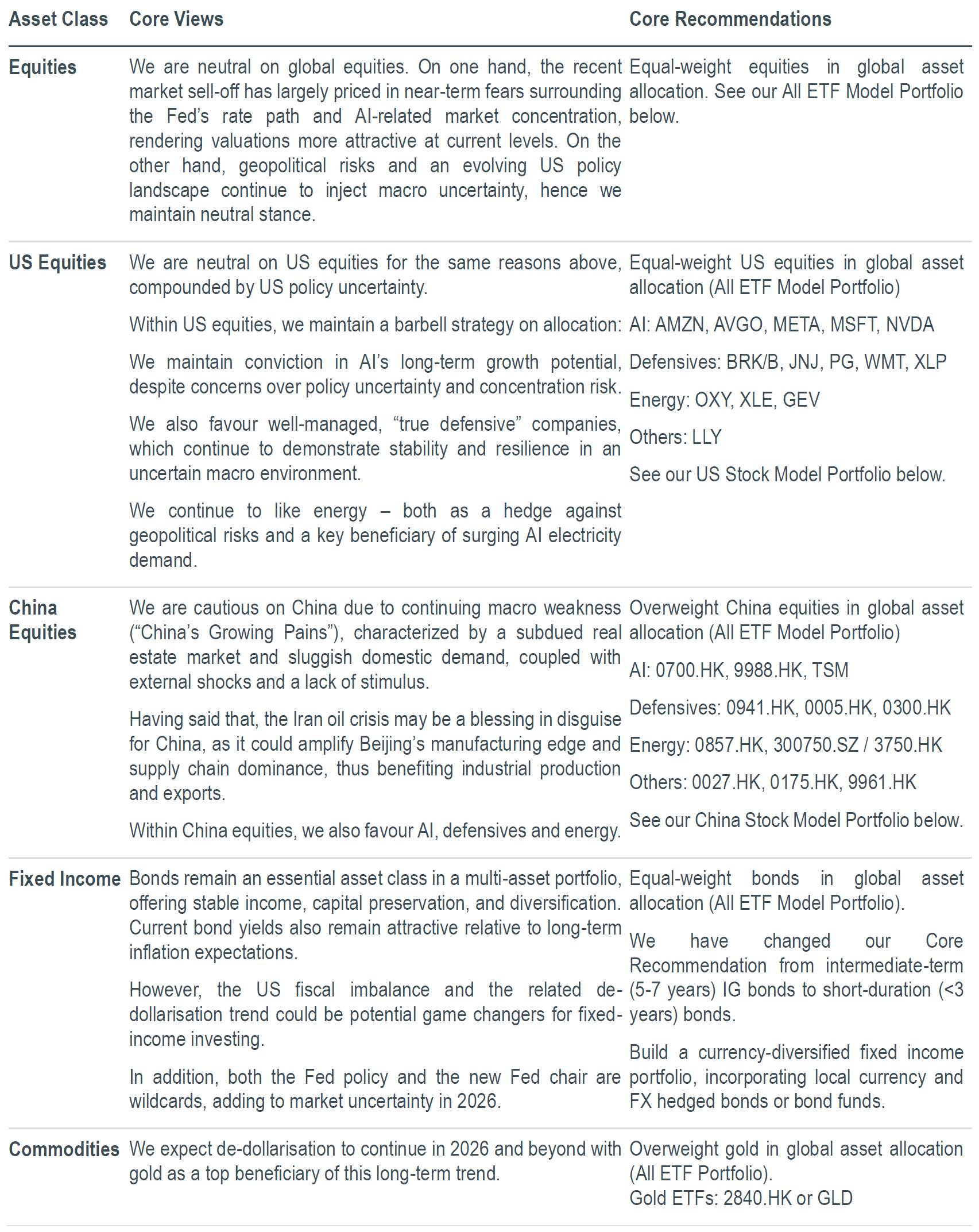
- Our All ETF Model Portfolio for global asset allocation lost 1.2% in October yet still gained 4.0% YTD. We’ve moved equities close to equal-weight, while remaining underweight fixed income and overweight gold.
- US equities: the “Sep-Oct” awakening has arrived. October played out largely as expected, as macro and regulatory headwinds triggered a sharp rotation out of high-beta AI stocks. With earnings fundamentals still robust, we maintain our Barbell Strategy of AI leaders + Defensives/Real Assets to balance ongoing macro shocks against resilient AI fundamentals.
- Our US Stock Model Portfolio gained 0.8% in October and returned 11.1% YTD. Top 3 performers: LLY +22.5%, WMT +18.9% and OXY +15.7%.
- China equities: selectivity remains key. China’s Growing Pains are increasingly feeding into macro data and corporate earnings. New market-support measures in October have failed to meaningfully lift sentiment, leaving the timing of a broader recovery uncertain. Against this backdrop, selectivity is key: we favour high-dividend defensive plays for income and downside protection.
- Our China Stock Model Portfolio dropped 4.1% in October and lost 12.2% YTD. Top 3 performers: 0857.HK +12%, 1288.HK +7.1% and 0300.HK +5.3%.
- Fixed income: A hawkish Fed keeps bond markets on edge, while the Treasury recovery does not signal the all-clear. Maintain our Core Recommendation on short-duration, high-quality corporate bonds.
Core Views and Recommendations
CIO Commentary
At the time of writing, the US stock market just suffered its worst one-day decline since April 4, 2025 (tariffs). A democratic sweep in the mid-term elections has heightened fears of tighter data centre restrictions, triggering panic-selling across AI-related stocks. To some extent, the sell-off validates our overall cautious stance on US equities and our call on the “Great AI Capex Cooldown” – one of our top predictions for 2026. While it’s encouraging to see our rigorous research has led to prescient forecasts, there are some important caveats.
- We may have overestimated macro pressures while underestimating AI’s resilience. Our top-down, macro concerns remain valid, including the Fed Wildcard, the Iran oil shock, persistent inflation and widening fiscal imbalances. However, past macro-driven selloffs in AI stocks were typically short-lived, lasting around one month or so (20 trading days). Before long, continuing strong AI fundamentals and robust corporate earnings drew investors back into the sector, leading to a speedy recovery.
- Local policy headwinds aren’t new, AI capex unfazed so far. The current sell-off is driven by potential AI data center restrictions in blue sweep states – particularly Texas, Georgia and Ohio – which are not only major hubs for data center expansion, but also will be democratic-controlled post-election. Such restrictions are not new; state and local scrutiny has been building throughout 2026 around power costs, grid capacity, water usage, permitting and tax incentives. By June, 14 states had already considered or were considering data-center moratoriums, while several states had begun tightening incentives or imposing additional safeguards. Yet these measures have done little to slow the AI capex boom so far, suggesting Big Tech firms may have found ways to navigate these constraints.
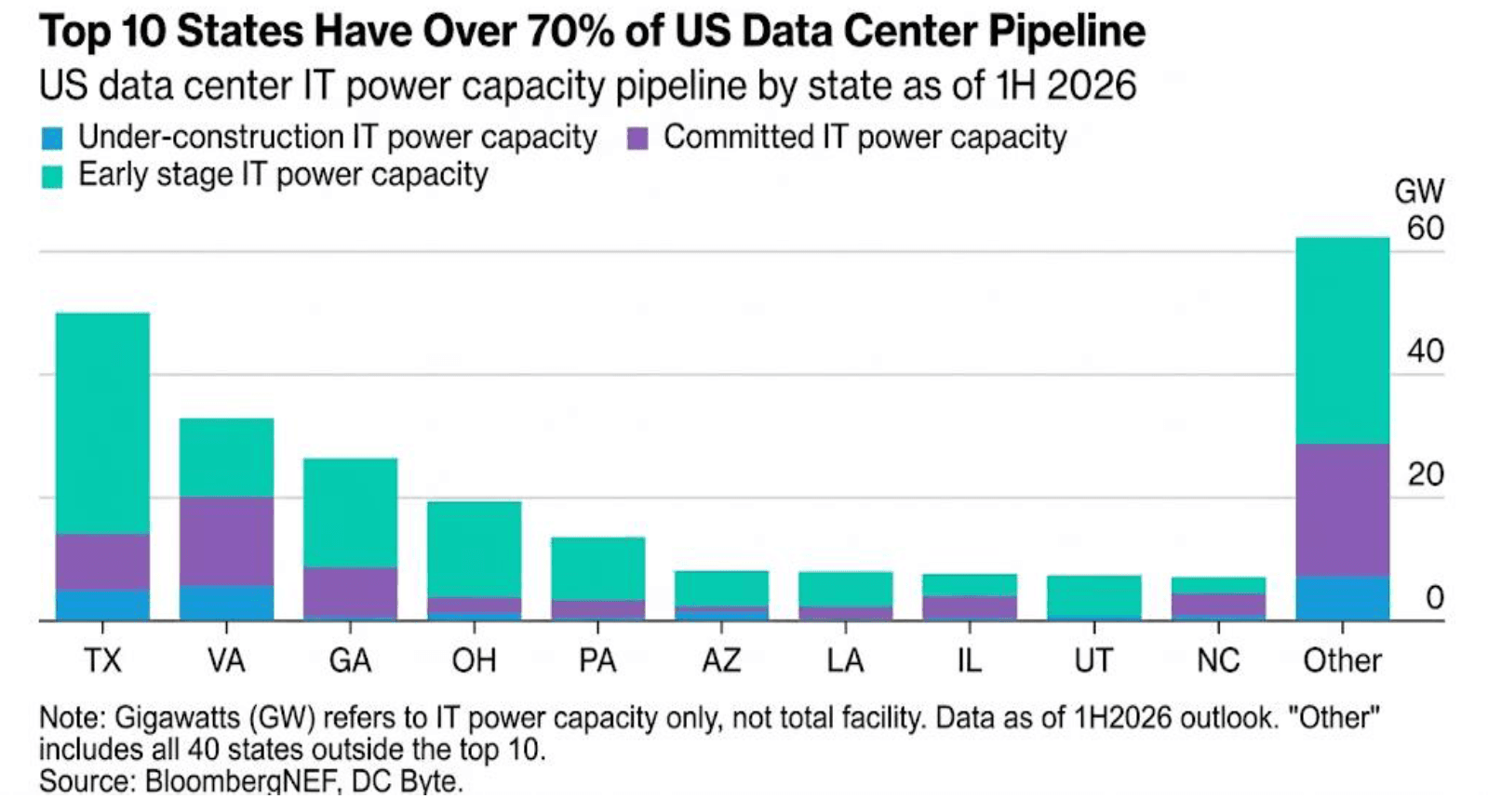
- 2027 largely locked in, focus on 2028 and beyond. Given 24–36 month construction lead times, most 2027 data-center expansion is already committed, limiting the impact of any new policies. Additional restrictions, if any, will likely bite from 2028 onward, creating medium-term uncertainty but also leaving plenty of time for hyperscalers to adapt.
- The strategic case against slowing AI. The US-China AI race should temper how far state-level restrictions can go. There is now broad bipartisan consensus that China is America’s No. 1 strategic competitor, and that Washington must maintain its AI leadership over Beijing. While this is primarily a federal priority, local policy cannot be completely divorced from the America’s strategic competition with China. Our US Strategist, Wendy Chen, made this point clearly in our latest CIO Series webinar.
- The economic case against over-regulation. Data centers bring substantial jobs, capital investment, tax revenues and infrastructure development. In Texas, data centers generate USD 65.8 billion in annual GDP contribution, support USD 4.5 billion in state and local tax revenue, and create jobs at a multiplier of roughly 5.5 to 5.7 (source: PwC). Therefore, states must carefully balance these economic benefits against the costs of any new restrictions.
Conclusion: The state policy risk is real, but more nuanced and medium-term in nature. Structural AI demand, the US-China AI Race and local economic incentives are all powerful counterweights. For now, the sell-off looks more sentiment- than fundamentals-driven. We remain positive on the AI supercycle and view the correction as a buying opportunity in select stocks.
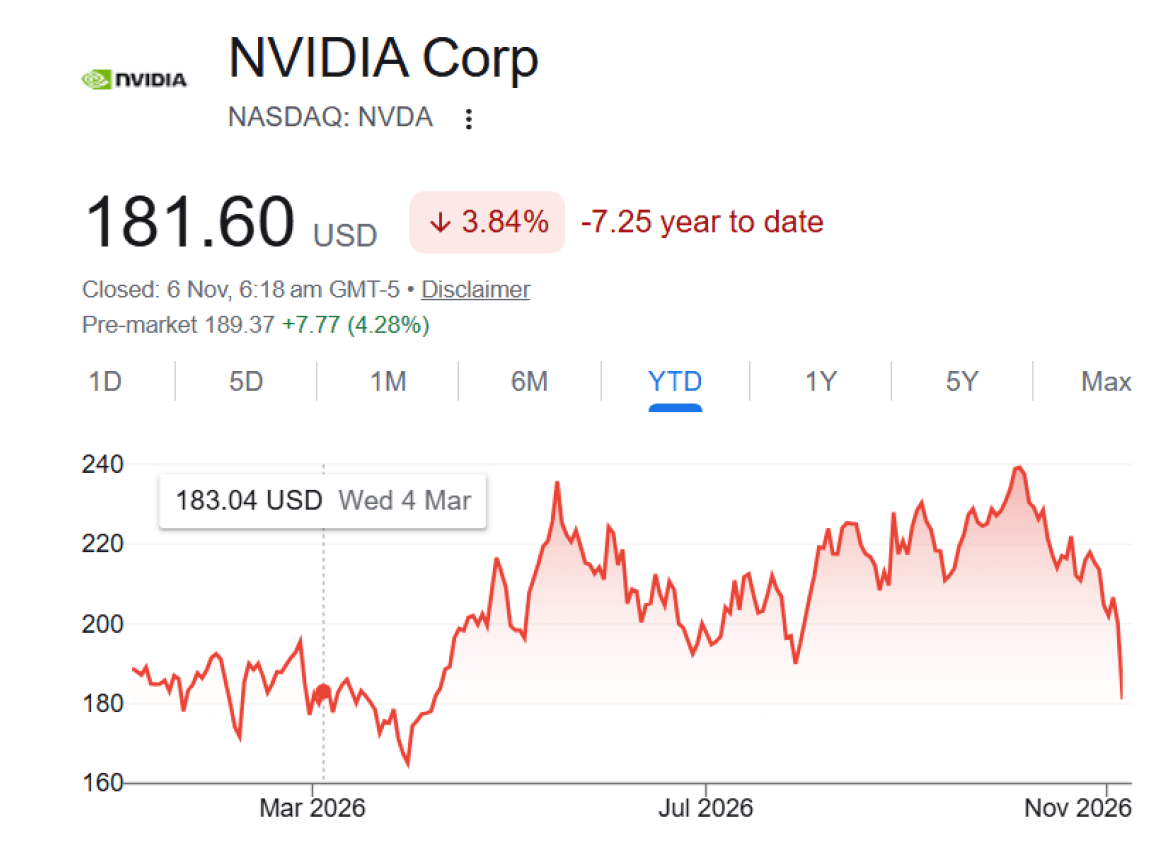
Call to action: Buy the dip selectively. Nvidia (NVDA) remains our top AI pick, as the undisputed king of AI compute and a major beneficiary of the AI infrastructure buildout. Please refer to our US Equities section for other stock recommendations.
Incidentally, Nvidia (NVDA) has already been declining for one month already since its October 5 peak, in line with the “one-month reset” described above and offering another attractive entry point for long-term investment.
Asset Allocation (All ETF Model Portfolio)
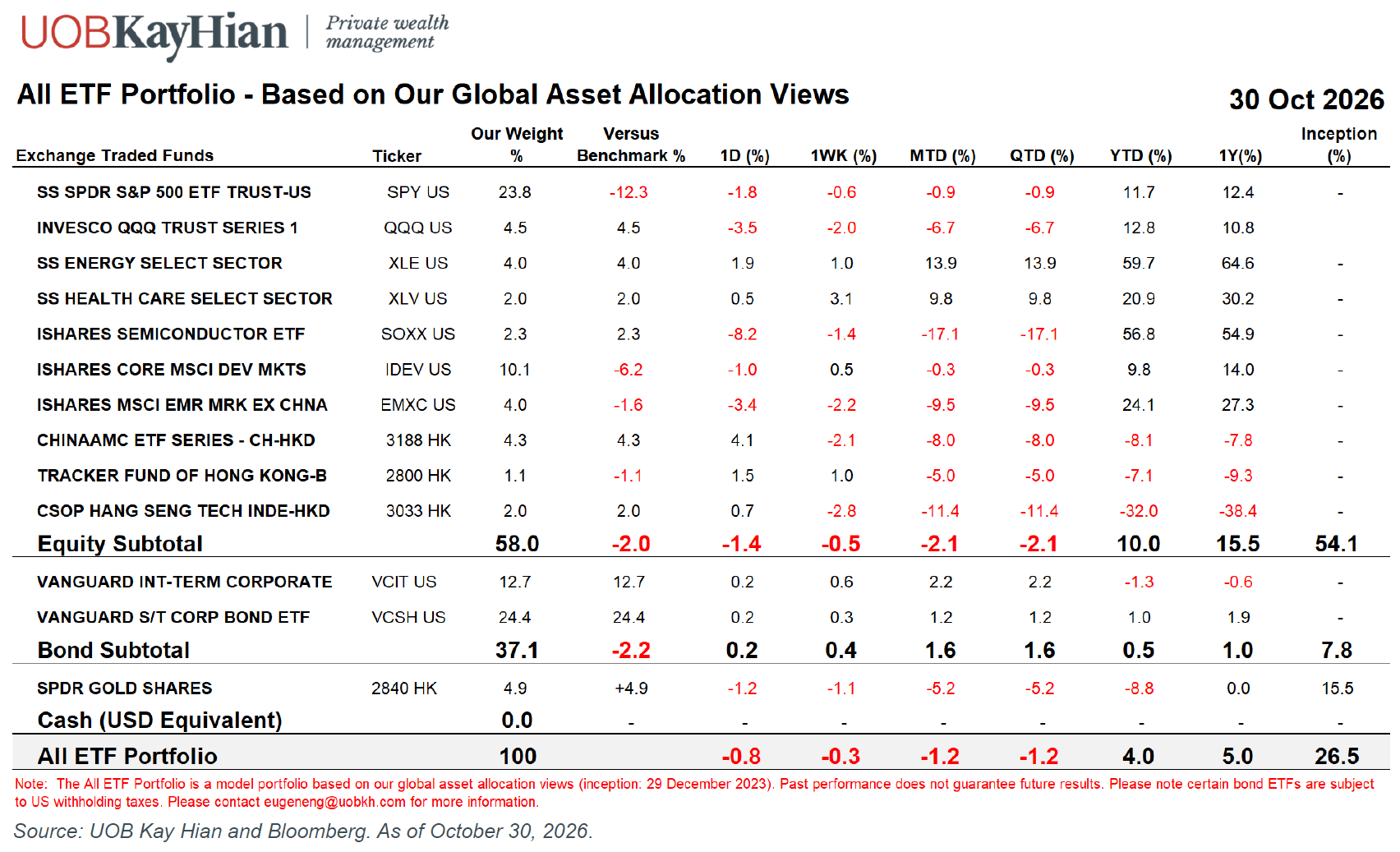
- Our All ETF Portfolio for global asset allocation was down 1.2% in October yet still up 4.0% YTD. Among our holdings, the Energy Sector ETF (XLE) was the top performer, gaining 13.9%. The Semiconductor Sector ETF (SOXX) and Hang Seng Tech ETF (3033.HK) were the biggest detractors, -17.1% and -11.4%, respectively.
- US Equities EQUAL-WEIGHT (36.6% vs. 36.6%). During the month, we gradually added to US market beta via the S&P 500 ETF (SPY), in anticipation of a post midterm election rally. We remain measured, however, having moved from a significant underweight to neutral rather than overweight. Within US equities, we also rotated from Industrials (XLI) into Healthcare (XLV) to position for potential policy changes under a Democratic Congress. While not all XLV stocks would benefit equally from a Democratic win, Healthcare could still face fewer headwinds than Industrials – which is increasingly driven by AI capex.
- Developed Markets ex-US UNDERWEIGHT (10.1% vs. 16.3%). DM ex-US (IDEV) was roughly flat in October, as macro pressures such as rising inflation and fiscal imbalances were largely offset by resilient corporate earnings. IDEV remains up 9.8% YTD.
- Emerging Markets ex-China UNDERWEIGHT (4.0% vs. 5.6%). EM ex-China (EMXC) fell by 9.5% last month, primarily driven by weakness in South Korea and Taiwan amid a sharp sell-off in AI-related stocks. Despite the recent pullback, EMXC remains one of the best performing regions globally, up 24.1% YTD.
- China Equities OVERWEIGHT (5.8% vs. 2.2%). Following the September correction, we added to both the CSI 300 Index ETF (3188.HK) and Hang Seng Tech ETF (3033.HK), supported by our view that valuations became more attractive despite “China’s Growing Pains”.
- Fixed Income UNDERWEIGHT (37.1% vs. 39.3%). Our bond ETFs delivered positive returns this month as US treasury yields retreated, with the Intermediate-term Corporate Bond ETF (VCIT) gaining 2.2% and the Short-term Corporate Bond ETF (VCSH) rising 1.2%. In October, we raised cash from trimming VCSH and redeployed the proceeds to SPY, in order to bring our equity underweight to a neutral position.
- Gold OVERWEIGHT (4.9% vs. 0.0%). Gold (2840.HK) declined another 5.2% in October, following a 6.3% fall in September. We’ve bought more gold on dips, as we continue to view gold as a valuable long-term hedge against geopolitical risks, currency volatility and de-dollarisation.
Equities
US Equities
October unfolded largely as we expected, transitioning from a tech-led rally early on to a sharp, macro-driven correction toward month-end and into early November (post the midterm elections). The S&P 500 retreated 0.9% last month, moderating its YTD return to 10.5%. Beneath the calm surface, however, there has been a brutal rotation out of high-beta AI momentum stocks, as investors fretted over AI credit concerns and regulatory headwind from the Democrat sweep.
- The "Sep-Oct Awakening" has arrived, albeit a few days later than we forecasted. The VIX (volatility index) punched through 20 intraday four times in October, mirroring the historical volatility we flagged ahead of the midterms. Goldman Sachs data reveals that hedge funds cut tech exposure at the fastest pace on record in October, with net leverage plunging to a 1-year low of 43%. We see the market trapped in a self-reinforcing loop, where heightened volatility triggered margin-call liquidations and impacted CTA/passive flows, with macro and regulatory headwinds adding fuel to the fire.
- Fed: Hawkish rhetoric, patient hands. The October FOMC kept rates steady, aligning with our expectations given the proximity of the midterm elections. A December rate hike remains our base case, currently priced at a ~72% probability. On the Fed balance sheet, Chair Warsh reassured markets that the dedicated QT task force will report back only in 1Q2027. Notably, the market's focus is shifting to AI financing; Warsh acknowledged tighter credit spreads in tech, emphasizing that it is the sector's changing financing structure—not just inherent rate sensitivity—that matters. His AI task force will hold a public hearing on Nov 16 to further discuss AI productivity and macro implications.
- 3Q earnings robust as expected. An impressive 82% of S&P 500 companies reported positive EPS surprises in October. S&P 500’s 3Q earnings growth stood at a robust 30%, marking the third consecutive quarter of 25%+ growth. Investors have been selective, but for good reasons. The market continues to reward strong earnings momentum while punishing those facing disruption or execution risks. For more details, please see our company comments below.
- Rotation reinforces our barbell strategy. As macro volatility persisted, investors rotated into defensive and yield-sensitive sectors. Energy (XLE) and Health Care (XLV) led the pack with 12.6%/10.0% gains in October. Meanwhile, Communication (XLC) and Information Technology (XLK) saw notable profit-taking amid concerns over AI credit risks. We maintain our Barbell Strategy (AI leaders + Defensives/Real assets) to navigate the current turbulence.
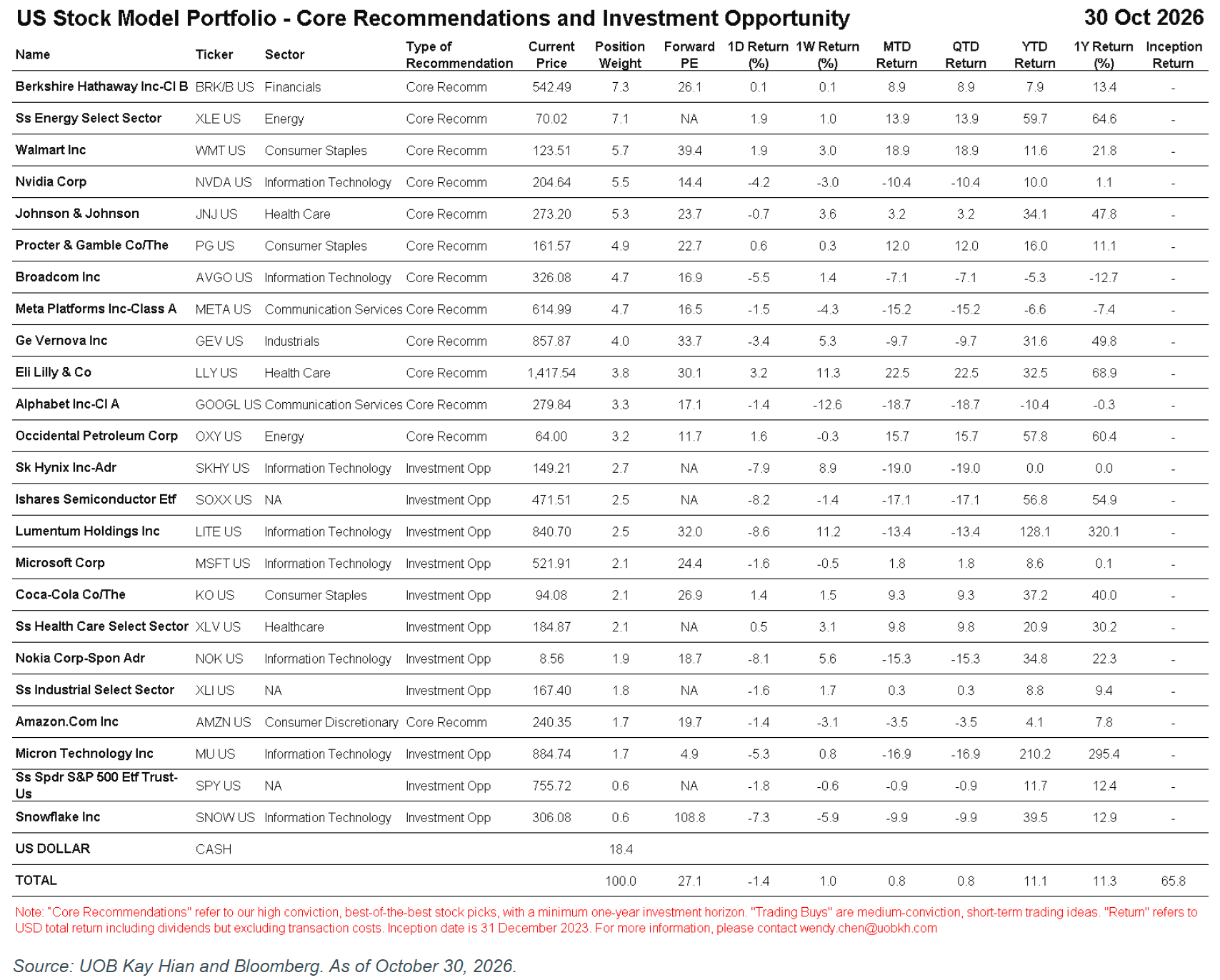
- Our US Stock Model Portfolio gained 0.8% in October and returned 11.1% YTD, outperforming S&P 500 (SPY) last month yet still underperforming the index YTD. The October alpha was driven by Energy (OXY +15.7%, XLE +13.9%), Health Care (JNJ +3.2%, XLV +9.8%, LLY +22.5%), and Consumer Staples (WMT +18.9%, PG +12%, KO +9.3%). This was partly offset by losses in Consumer Discretionary (AMZN -3.5%), Information Technology (SKHY -19%, MU -16.9%, LITE -13.4%, NVDA -10.4%, SNOW -9.9%, GOOGL -18.7%, SOXX -17.1%) and Communication Services (META -15.2%).
- Cash fell to 18.4% at October-end, as we bought stocks in anticipation of a potential post-midterm rally.
- Top 3 performers: LLY +22.5%, WMT +18.9% and OXY +15.7%.
- Bottom 3 performers: SKHY -19%, GOOGL -18.7% and SOXX -17.1%.
- Microsoft (MSFT) delivered a quarterly beat, as Azure revenue (36% of total revenue) saw growth accelerating to 48% yoy and Office 365 revenue (34% of total) grew 18% yoy – both above expectations. Copilot daily active users (DAUs) grew 50% qoq, indicating broadening enterprise AI adoption. Our channel checks indicate several large enterprises are expanding Copilot seat purchases, amid early stages of AI application deployment. Microsoft expects FCF to remain positive through FY2027 (June), making it the only hyperscaler expected to do so. Its positive FCF reflects a more disciplined approach to AI spending, including greater use of off-balance sheet leasing. The latest earnings largely reinforce our investment thesis on Microsoft as an enduring enterprise AI leader.
- Amazon (AMZN) missed on both revenue and cloud growth. 3Q revenue grew 12% yoy, missing consensus by ~1% as online stores (34% of total revenue) grew only 2%. AWS (23% of revenue) increased 39.3% yoy, slightly lower than buyside expectations of 40%+. Operating income grew by 61% yoy, while operating margin reached a record 13.9%, driven largely by a richer mix of AWS (63% of operating income). While the results seem muted, our long-term investment thesis is unchanged. Management continued to guide 40% annual growth in AWS for 2027 and 2028, while highlighting that spending on Amazon Bedrock (AI application and agent platform) increased 7x yoy. This shows that enterprises are still in very early stages of deploying AI inference at scale. Inference already accounts for well over half of AWS's AI-related revenue and continues to grow rapidly.
- Alphabet (GOOGL) missed 3Q revenue expectation by 6%, as advertising (64% of total revenue) growth slowed to 12% yoy and came in below expectations. As we highlighted recently, Search is facing a structural shift in user behavior. As a result, our channel checks indicate portions of advertising budgets are increasingly re-allocated from Google to Meta. However, we believe Google can defend itself by launching its own AI agents, similar to its AI Mode rollout. Google Cloud (24% of total revenue) remains robust and surged 103%, ahead of buyside expectations of ~100%. This was driven by continuing strong AI demand (TPU, data and cybersecurity). We expect Google's TPU deployment to drive cloud capacity expansion and revenue growth (80% growth expected) in 2027.
- Meta (META) reported strong earnings, with 3Q revenue up 26% yoy, beating consensus by 2%. Adjusted EPS came in at USD 7.40, above the USD 6.54 street estimate. Worth noting also is that free cash flow turned negative for the first time due to elevated AI capex. However, Meta’s strong advertising performance, combined with encouraging progress in AI agents, further reinforces our view that the company remains an AI application leader. As we predicted, Meta initiated a massive USD 97.5bn financing and stock issuance plan (USD 25bn common shares, USD 60bn non-voting shares At-The-Market starting in 2027, USD 12.5 billion preferred shares). The USD 25bn Class A common stock offering was 5x oversubscribed, reflecting investor optimism in Meta’s outlook.
- Eli Lilly (LLY) delivered another impressive beat-and-raise, cementing its status as the healthcare sector's premier leader. Its 3Q2026 revenue surged 39% yoy to USD 24.4bn, and adjusted EPS coming in a massive 33% ahead of consensus. The quarter was propelled by blockbuster weight-loss drug demand, with sales volume jumping 53% and more than offsetting a 15% price drop (related to China's national reimbursement policy etc.). Growth doesn’t stop here. management raised its FY2026 revenue guidance for the third time this year to USD 91-92bn (from USD 85-87bn). We reiterate LLY as a Core Recommendation, as the stellar results strongly reinforce our thesis on its distinct product advantage and flawless execution. Since we started recommending the name in June, the stock has significantly outperformed the market, +24% versus the S&P 500's +4% return.
- Procter & Gamble (PG) shares surged 6% following a robust beat, with organic sales jumping +4.0% (vs. +2.2% est) on broad-based strength and EPS coming in at USD 2.0 (vs. USD 1.9 est), driven by a favourable SG&A deleverage that pushed operating margins to a better-than-expected 25.9%. Looking ahead, management largely reiterated its guidance on FY2027 organic sales (+1-3%) and core EPS (flat to +3%), while raising the net sales outlook to +2-4% following the USD 3.8bn acquisition of Thorne to expand its premium health and wellness footprint. Despite its strong execution, macro pressures remain. Management flagged meaningfully higher cost pressures for the remainder of the year, increasing the FY2027 after-tax commodity, energy, and transportation headwind to USD 1.4bn based on a ~USD100/bbl Brent oil price. We reiterate PG as our Core Recommendation as its resilient results reinforce the company as a “True Defensive” play amid persistent macro uncertainty.
- Coca-Cola (KO) reported a robust 3Q2026 beat, with organic revenue surging +7% yoy (vs. +4% consensus), driven by impressive concentrate (+7%) and unit case (+5%) volume growth, particularly in Latin America (+16%) and EMEA (+7%). This top-line leverage drove a gross margin of 62.7%, translating to a 3Q2026 EPS beat of USD 0.91 vs. USD 0.88 expected. Management raised its FY2026 guidance, now expecting organic revenue growth of at least ~5% and FX-neutral EPS growth of at least +9% (up from +7-8%), implying full-year reported EPS growth of +11%. We continue to like KO's execution and defensive nature in a challenging macro environment.
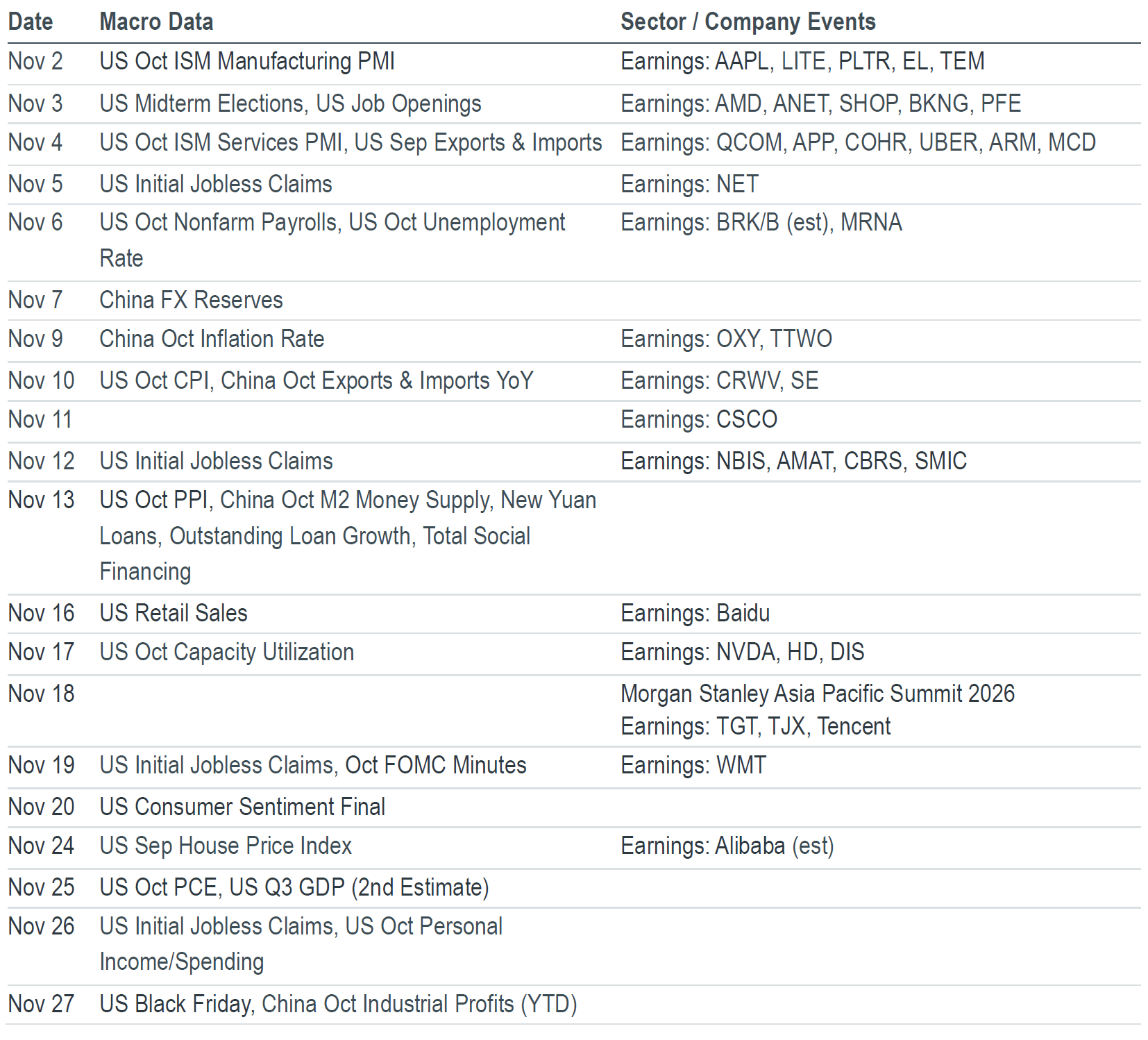
- Must watch events for November: US Midterm Elections and Job Openings (Nov 3), US Nonfarm Payrolls and Unemployment Rate (Nov 6), US CPI (Nov 10), US Retail Sales (Nov 16), Oct FOMC Minutes (Nov 19), and US Q3 GDP (2nd Estimate) and PCE (Nov 25), alongside major corporate earnings from AMD, QCOM (Nov 4), NVDA (Nov 17), TGT, WMT (Nov 18–19), and Alibaba (Nov 24). For more information, please see Appendix B.
China Equities
China fell further in October with the Hang Seng Index -5.4%, the Hang Seng Tech Index -11.7% and the CSI 300 (A-shares) -8.5% last month. China’s Growing Pains continue to weigh on macro data and seep into corporate earnings – making stock selection (selectivity) key in the current environment. We favour high-dividend yield (HDY), defensive stocks for income and downside protection.
- China’s Growing Pains remain unresolved. GDP growth accelerated to 4.5% yoy in 3Q from 4.3% in 2Q, but sluggish domestic demand remained a reality. Sep retail sales rose just 1.1%, while fixed-asset investment fell 7.2% yoy in Jan-Sep, led by a 20.6% decline in property investment. Weak investment and consumption continue to hinder a broad recovery.
- Weak demand constrains cost pass-through. Manufacturing PMI fell to 49.3 in October from 50.1 in September, while high-tech manufacturing remained in expansion at 51.3. The input-price index of 56.8 exceeded the factory-gate price index of 51.7, suggesting limited cost pass-through and growing margin pressure for manufacturers. We think weak demand limits manufacturers’ ability to pass on higher material costs, keeping their margins under pressure.
- Indirect support for stocks. The PBOC is pushing faster use of the existing RMB 800bn in market-stabilisation tools, the swap facility and buyback relending programme. Specific measures include a RMB 100bn swap operation on Nov 3 and a 25bp cut in the buyback relending rate to 1%. China is also reportedly suspending IPOs to further support the stock market. This could reduce share supply and boost investor sentiment if confirmed. In the absence of a major stimulus package, these modest market-support measures could be viewed as a form of stimulus.
- Muted market response. On the announcement day (Nov 3), the CSI 300 fell 0.2% and the Hang Seng Index gained 0.57%, suggesting the “stimulus” was largely ineffective. With macro and corporate fundamentals still weak, we see the Hang Seng Index trading within 23,000–26,000 through year-end, perhaps even into 1Q2027. Recovery timing and magnitude remain uncertain, reinforcing our preference for high-dividend defensive (see below).
- Selectivity is key: buy defensive yield plays and get paid to wait. We favour China Mobile (0941.HK; 6.7% yield), PetroChina (0857.HK; 5.4%), Midea (0300.HK; 4.4%) and Central SOE High Dividend Yield ETF (3437.HK; 7.1%) for income and downside protection, while waiting patiently for a real recovery. All are our Core Recommendations except 3437.HK.
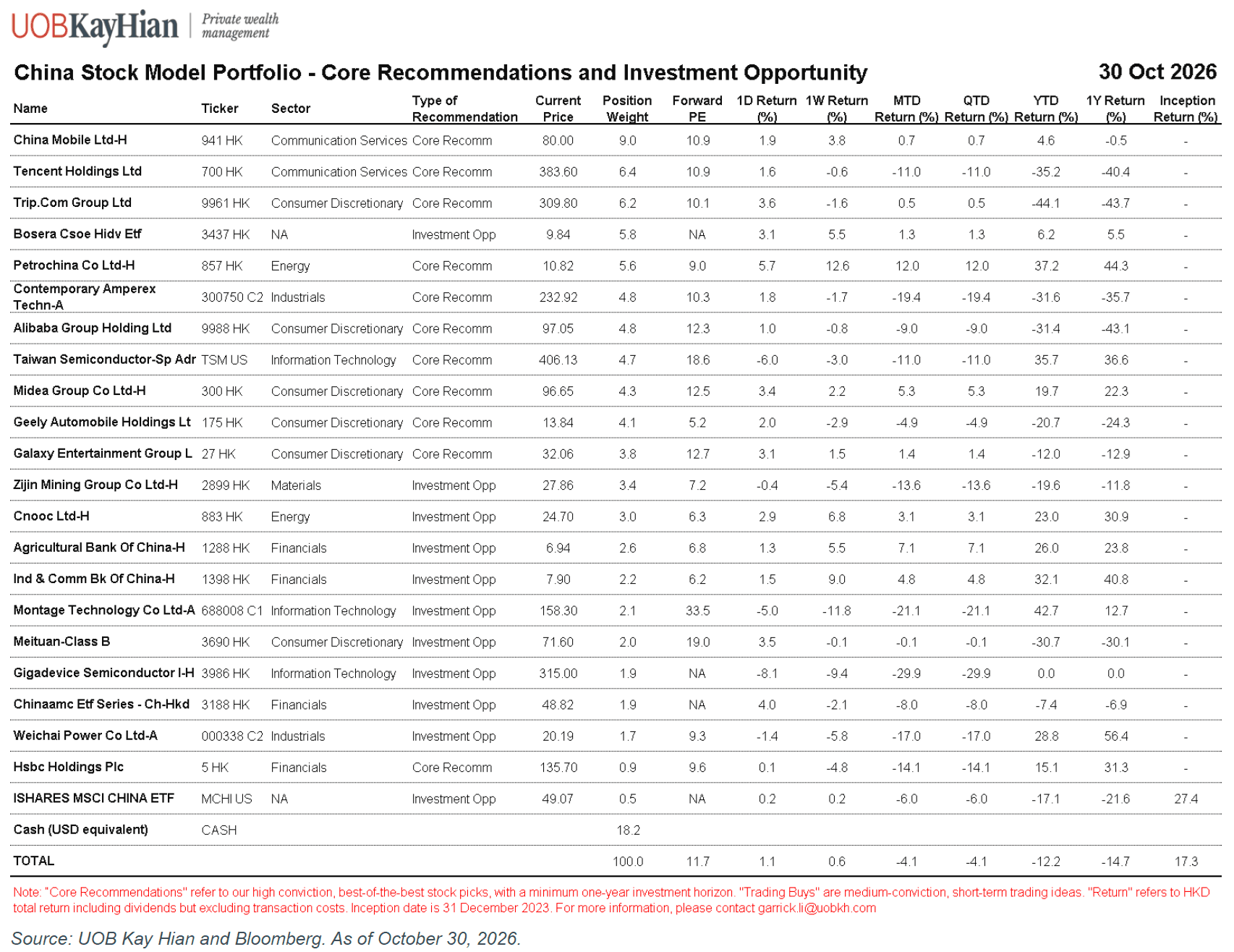
- Our China Stock Model Portfolio dropped 4.1% in October, outperforming the MSCI China ETF (MCHI -6%). The portfolio was down 12.2% YTD, also outperforming MCHI’s 17.1% decline.
- Cash fell slightly to 18.2% at month-end, compared with 19.3% in September.
- Top 3 performers: 0857.HK +12%, 1288.HK +7.1% and 0300.HK +5.3%.
- Bottom 3 performers: 3986.HK -29.9%, 300750.SZ -19.4% and 000338.SZ -17%.
- China Mobile (0941.HK) reported 3Q earnings miss, with net profit falling 12.2% yoy to RMB 27.3bn, roughly 6% below consensus. Profit excluding non-recurring items was broadly flat at RMB 28.7bn, but EBITDA fell 6.9%, showing continued pressure on core operations. Nine-month operating cash flow still rose 15.1% to RMB 185.3bn, supporting consistent dividends. We reiterate China Mobile as a Core Recommendation for its defensive nature, high dividend yield and potential for an AI-driven re-rating (as a key player in China’s AI infrastructure buildout).
- CATL (300750.SZ) missed 3Q earnings despite strong revenue growth. Revenue rose 58.6% yoy to RMB 165.2bn, but net profit increased only 14.5% yoy to RMB 21.25bn and fell 5.8% qoq, along with a gross margin compression of 2.5ppt qoq to 20.7%. The margin squeeze was mainly due to a greater share of lower-value products, alongside consumption-tax and export-rebate pressures. Quarterly operating cash flow fell to RMB 1.41bn in 3Q from RMB 26.54bn in 2Q, partly due to faster supplier payments. Following a 20% share price decline in Oct, CATL A-shares look increasingly attractive at a single-digit 2027F P/E, based on our long-term expectations for sustainable earnings growth 20%+ and gross margins above 20%+. Our investment thesis for CATL remains on its technology leadership, vertical integration, scale advantage and product reliability, with overseas expansion and energy storage driving growth beyond domestic EVs.
- Midea (0300.HK) delivered 3Q results broadly in line with recently lowered expectations. Revenue fell 4% to RMB 108.0bn, as weak domestic appliance demand outweighed growth of 8% in building solutions and 10% in automation. Cost savings nevertheless lifted core operating margin modestly both yoy and qoq to 10.6%. Net profit excluding CXMT gains fell around 10%. For 2026F, management targets broadly stable cash returns through dividends and buybacks, implying an estimated combined yield of 7%. Net cash and available-for-sale financial assets totaled RMB 230bn, over five times annual shareholder distributions. We retain Midea as a Core Recommendation for its defensive business, resilient margins, overseas brand development and promising commercial and industrial businesses. This remains a top pick under our China Export Shock 2.0 and China Maxxing themes.
- Geely (0175.HK) reported 3Q earnings miss. Net profit rose 28% yoy to RMB 4.84bn, around 7% below consensus. Core profit grew 32% yoy to RMB 5.21bn, but core profit per vehicle fell roughly 10% qoq as gross margin narrowed to 18.0%. Management expects a better 4Q, with a recovery in profit per vehicle to turn higher sales into stronger earnings. Exports remain a bright spot: management is aiming for around 1mn overseas sales in 2026, above its previously announced 920,000 target. We reiterate Geely as a Core Recommendation for its “quality growth” potential through its premium brands, profitable overseas expansion and efficiency gains from “One Geely” integration.
- TSMC (TSM) delivered a solid 3Q, with revenue/EPS modestly beating expectations while 2026 revenue growth guidance was raised to ~44% from slightly above 40%. AI chip demand remained strong. Management noted “no sign of a slowdown” and guided mid-to-high-50% CAGR in AI revenue (~35% of total revenue in 2026) for 2024-2029. Worth noting that CPUs are not counted in its AI revenue, meaning surging CPU demand (also driven by AI) may provide additional upside. We remain positive on TSMC and continue to view this as a high-certainty beneficiary of AI chip growth across GPUs, CPUs, ASICs, and advanced packaging.
- Must-watch events for the rest of November include October trade, CPI and PPI (Nov 9); retail sales, industrial production, investment, property and unemployment (Nov 16); LPR (Nov 20); industrial profits (Nov 27); November NBS PMI and Top 100 developer sales (month-end). Earnings: Tencent (Nov 18); Alibaba, Meituan and Trip.com (dates TBC).
Fixed Income
Below is the CIO Summary from our latest Fixed Income Monthly (5 Nov 2026), for Professional / Accredited Investors only. Ping Benjamin Tan at benjamintan@uobkh.com if you’d like to receive the full report.
- Hawkish Fed keeps fixed income on edge. The US economy continues to navigate a delicate mix of re-accelerating inflation and narrowing growth, prompting the Fed to deliver a “hawkish hold” in October. With markets pricing a ~70% probability of a December hike and attention shifting toward AI financing risk, we expect the macro backdrop for fixed income to remain fragile into the final stretch of 2026.
- Neocloud credit: AI’s weakest link. Within AI, neocloud credit cracks are emerging as high leverage, negative free cash flow and large refinancing needs expose the ecosystem’s weakest links. For now, stress appears localized rather than systemic, but contagion risk could rise if AI monetization disappoints.
- Treasury recovery does not signal the all-clear. The recent Treasury rally (prices up, yields down) is encouraging, but we do not believe long-term yields have topped out yet. Lingering inflation uncertainty, fiscal concerns and heavy AI-related corporate debt supply could renew upward pressure on yields, supporting our cautious stance on duration.
- Call to Action. We maintain our Core Recommendation on short-duration (<3 years), top-rated (A and above) investment-grade bonds. We suggest investors avoid aggressively adding duration until a clearer trading range for long-term yields is established.
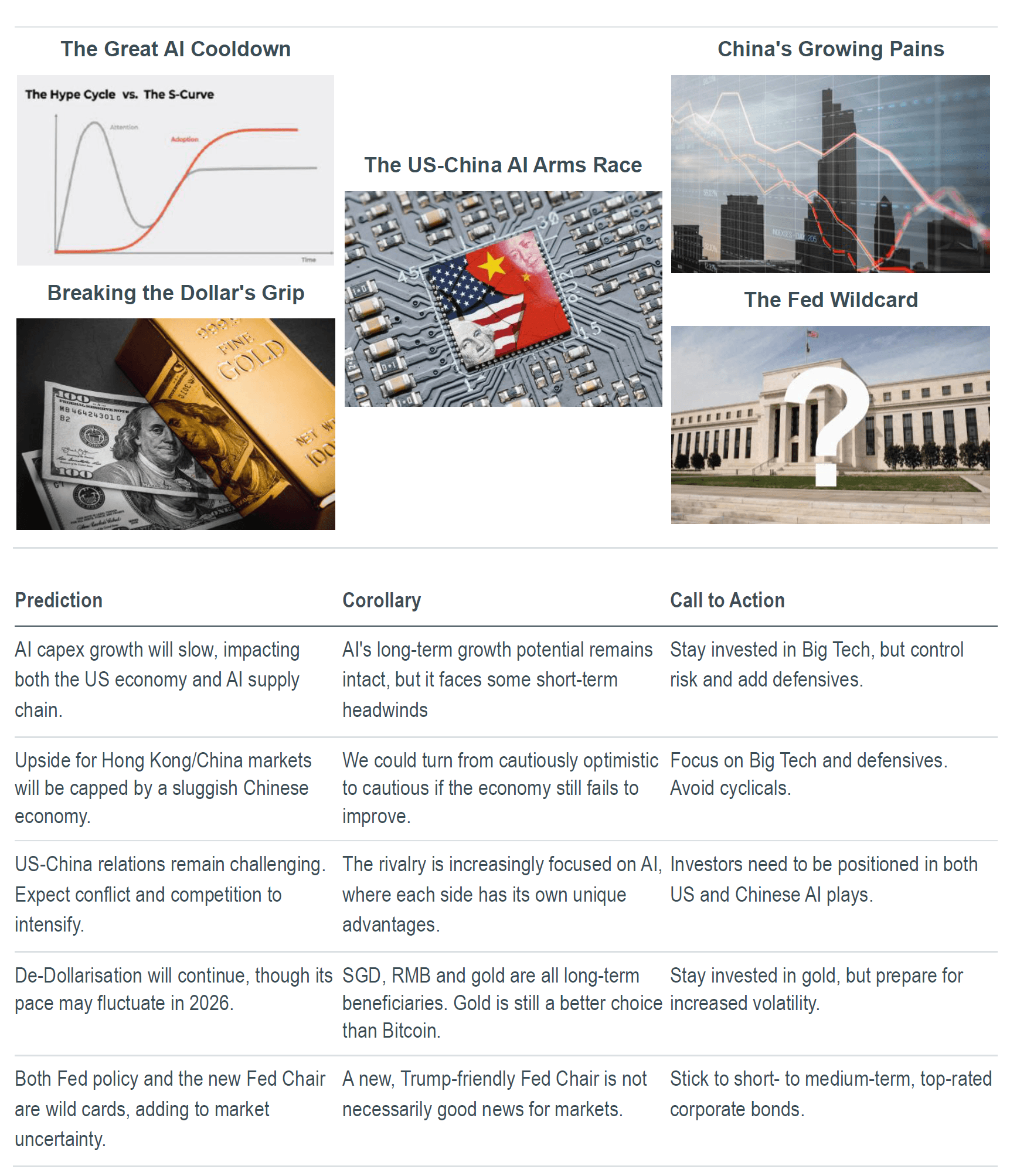
Appendix A: Our Top Five Predictions for 2026
Appendix B: Must Watch Events for November 2026
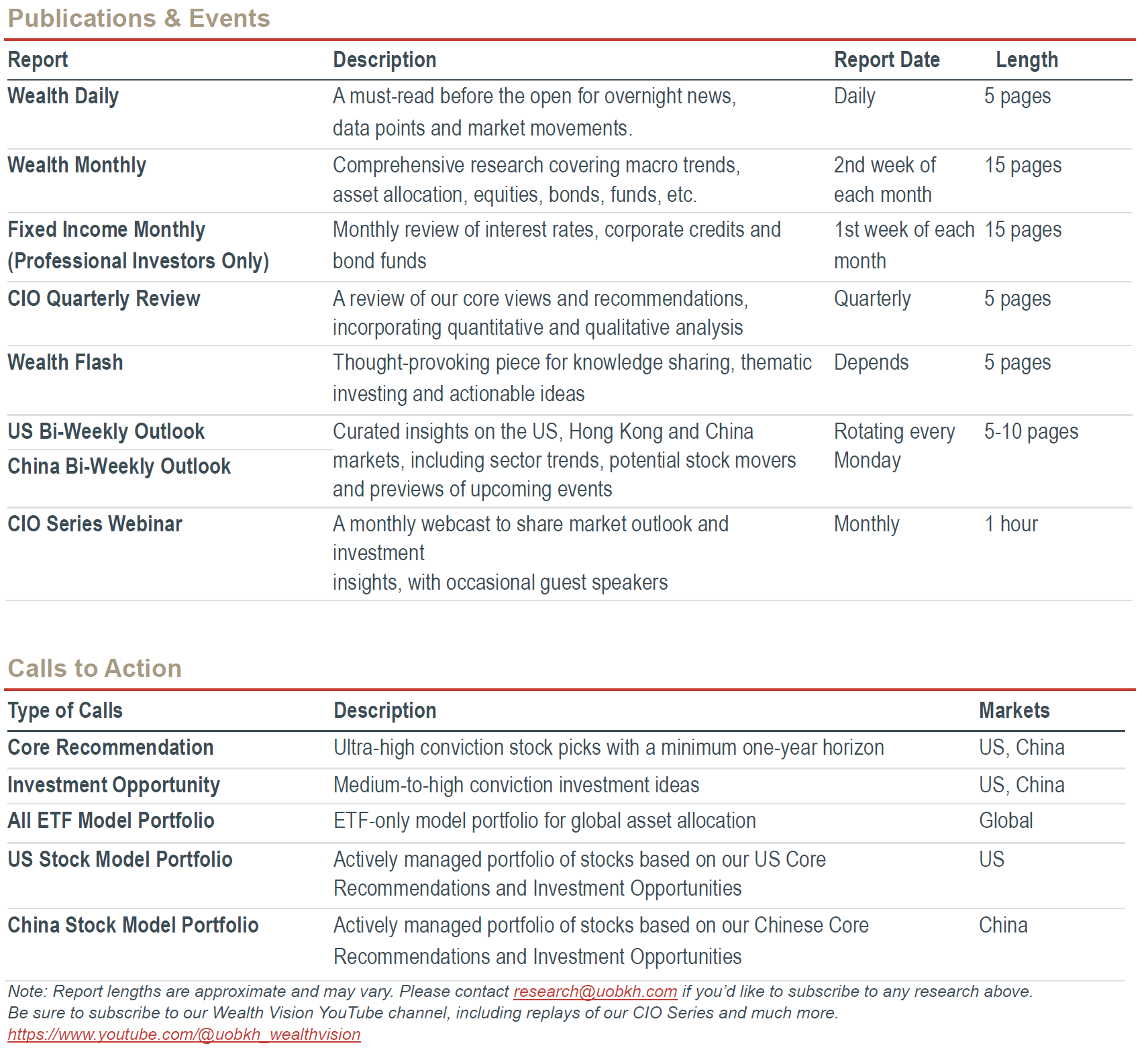
Appendix C: Roadmap to Private Wealth Management Research
CIO Summary
- AI bull case remains intact despite policy headwinds. The state policy risk for AI is real, but nuanced and medium-term in nature. Structural AI demand, the US-China AI Race and local economic incentives are all powerful counterweights. For now, the recent US market sell-off looks more sentiment- than fundamentals-driven. We remain positive on the AI supercycle and view the correction as a buying opportunity in select stocks.
- Our All ETF Model Portfolio for global asset allocation lost 1.2% in October yet still gained 4.0% YTD. We’ve moved equities close to equal-weight, while remaining underweight fixed income and overweight gold.
- US equities: the “Sep-Oct” awakening has arrived. October played out largely as expected, as macro and regulatory headwinds triggered a sharp rotation out of high-beta AI stocks. With earnings fundamentals still robust, we maintain our Barbell Strategy of AI leaders + Defensives/Real Assets to balance ongoing macro shocks against resilient AI fundamentals.
- Our US Stock Model Portfolio gained 0.8% in October and returned 11.1% YTD. Top 3 performers: LLY +22.5%, WMT +18.9% and OXY +15.7%.
- China equities: selectivity remains key. China’s Growing Pains are increasingly feeding into macro data and corporate earnings. New market-support measures in October have failed to meaningfully lift sentiment, leaving the timing of a broader recovery uncertain. Against this backdrop, selectivity is key: we favour high-dividend defensive plays for income and downside protection.
- Our China Stock Model Portfolio dropped 4.1% in October and lost 12.2% YTD. Top 3 performers: 0857.HK +12%, 1288.HK +7.1% and 0300.HK +5.3%.
- Fixed income: A hawkish Fed keeps bond markets on edge, while the Treasury recovery does not signal the all-clear. Maintain our Core Recommendation on short-duration, high-quality corporate bonds.
Core Views and Recommendations
CIO Commentary
At the time of writing, the US stock market just suffered its worst one-day decline since April 4, 2025 (tariffs). A democratic sweep in the mid-term elections has heightened fears of tighter data centre restrictions, triggering panic-selling across AI-related stocks. To some extent, the sell-off validates our overall cautious stance on US equities and our call on the “Great AI Capex Cooldown” – one of our top predictions for 2026. While it’s encouraging to see our rigorous research has led to prescient forecasts, there are some important caveats.
- We may have overestimated macro pressures while underestimating AI’s resilience. Our top-down, macro concerns remain valid, including the Fed Wildcard, the Iran oil shock, persistent inflation and widening fiscal imbalances. However, past macro-driven selloffs in AI stocks were typically short-lived, lasting around one month or so (20 trading days). Before long, continuing strong AI fundamentals and robust corporate earnings drew investors back into the sector, leading to a speedy recovery.
- Local policy headwinds aren’t new, AI capex unfazed so far. The current sell-off is driven by potential AI data center restrictions in blue sweep states – particularly Texas, Georgia and Ohio – which are not only major hubs for data center expansion, but also will be democratic-controlled post-election. Such restrictions are not new; state and local scrutiny has been building throughout 2026 around power costs, grid capacity, water usage, permitting and tax incentives. By June, 14 states had already considered or were considering data-center moratoriums, while several states had begun tightening incentives or imposing additional safeguards. Yet these measures have done little to slow the AI capex boom so far, suggesting Big Tech firms may have found ways to navigate these constraints.
- 2027 largely locked in, focus on 2028 and beyond. Given 24–36 month construction lead times, most 2027 data-center expansion is already committed, limiting the impact of any new policies. Additional restrictions, if any, will likely bite from 2028 onward, creating medium-term uncertainty but also leaving plenty of time for hyperscalers to adapt.
- The strategic case against slowing AI. The US-China AI race should temper how far state-level restrictions can go. There is now broad bipartisan consensus that China is America’s No. 1 strategic competitor, and that Washington must maintain its AI leadership over Beijing. While this is primarily a federal priority, local policy cannot be completely divorced from the America’s strategic competition with China. Our US Strategist, Wendy Chen, made this point clearly in our latest CIO Series webinar.
- The economic case against over-regulation. Data centers bring substantial jobs, capital investment, tax revenues and infrastructure development. In Texas, data centers generate USD 65.8 billion in annual GDP contribution, support USD 4.5 billion in state and local tax revenue, and create jobs at a multiplier of roughly 5.5 to 5.7 (source: PwC). Therefore, states must carefully balance these economic benefits against the costs of any new restrictions.
Conclusion: The state policy risk is real, but more nuanced and medium-term in nature. Structural AI demand, the US-China AI Race and local economic incentives are all powerful counterweights. For now, the sell-off looks more sentiment- than fundamentals-driven. We remain positive on the AI supercycle and view the correction as a buying opportunity in select stocks.
Call to action: Buy the dip selectively. Nvidia (NVDA) remains our top AI pick, as the undisputed king of AI compute and a major beneficiary of the AI infrastructure buildout. Please refer to our US Equities section for other stock recommendations.
Incidentally, Nvidia (NVDA) has already been declining for one month already since its October 5 peak, in line with the “one-month reset” described above and offering another attractive entry point for long-term investment.
Asset Allocation (All ETF Model Portfolio)
- Our All ETF Portfolio for global asset allocation was down 1.2% in October yet still up 4.0% YTD. Among our holdings, the Energy Sector ETF (XLE) was the top performer, gaining 13.9%. The Semiconductor Sector ETF (SOXX) and Hang Seng Tech ETF (3033.HK) were the biggest detractors, -17.1% and -11.4%, respectively.
- US Equities EQUAL-WEIGHT (36.6% vs. 36.6%). During the month, we gradually added to US market beta via the S&P 500 ETF (SPY), in anticipation of a post midterm election rally. We remain measured, however, having moved from a significant underweight to neutral rather than overweight. Within US equities, we also rotated from Industrials (XLI) into Healthcare (XLV) to position for potential policy changes under a Democratic Congress. While not all XLV stocks would benefit equally from a Democratic win, Healthcare could still face fewer headwinds than Industrials – which is increasingly driven by AI capex.
- Developed Markets ex-US UNDERWEIGHT (10.1% vs. 16.3%). DM ex-US (IDEV) was roughly flat in October, as macro pressures such as rising inflation and fiscal imbalances were largely offset by resilient corporate earnings. IDEV remains up 9.8% YTD.
- Emerging Markets ex-China UNDERWEIGHT (4.0% vs. 5.6%). EM ex-China (EMXC) fell by 9.5% last month, primarily driven by weakness in South Korea and Taiwan amid a sharp sell-off in AI-related stocks. Despite the recent pullback, EMXC remains one of the best performing regions globally, up 24.1% YTD.
- China Equities OVERWEIGHT (5.8% vs. 2.2%). Following the September correction, we added to both the CSI 300 Index ETF (3188.HK) and Hang Seng Tech ETF (3033.HK), supported by our view that valuations became more attractive despite “China’s Growing Pains”.
- Fixed Income UNDERWEIGHT (37.1% vs. 39.3%). Our bond ETFs delivered positive returns this month as US treasury yields retreated, with the Intermediate-term Corporate Bond ETF (VCIT) gaining 2.2% and the Short-term Corporate Bond ETF (VCSH) rising 1.2%. In October, we raised cash from trimming VCSH and redeployed the proceeds to SPY, in order to bring our equity underweight to a neutral position.
- Gold OVERWEIGHT (4.9% vs. 0.0%). Gold (2840.HK) declined another 5.2% in October, following a 6.3% fall in September. We’ve bought more gold on dips, as we continue to view gold as a valuable long-term hedge against geopolitical risks, currency volatility and de-dollarisation.
Equities
US Equities
October unfolded largely as we expected, transitioning from a tech-led rally early on to a sharp, macro-driven correction toward month-end and into early November (post the midterm elections). The S&P 500 retreated 0.9% last month, moderating its YTD return to 10.5%. Beneath the calm surface, however, there has been a brutal rotation out of high-beta AI momentum stocks, as investors fretted over AI credit concerns and regulatory headwind from the Democrat sweep.
- The "Sep-Oct Awakening" has arrived, albeit a few days later than we forecasted. The VIX (volatility index) punched through 20 intraday four times in October, mirroring the historical volatility we flagged ahead of the midterms. Goldman Sachs data reveals that hedge funds cut tech exposure at the fastest pace on record in October, with net leverage plunging to a 1-year low of 43%. We see the market trapped in a self-reinforcing loop, where heightened volatility triggered margin-call liquidations and impacted CTA/passive flows, with macro and regulatory headwinds adding fuel to the fire.
- Fed: Hawkish rhetoric, patient hands. The October FOMC kept rates steady, aligning with our expectations given the proximity of the midterm elections. A December rate hike remains our base case, currently priced at a ~72% probability. On the Fed balance sheet, Chair Warsh reassured markets that the dedicated QT task force will report back only in 1Q2027. Notably, the market's focus is shifting to AI financing; Warsh acknowledged tighter credit spreads in tech, emphasizing that it is the sector's changing financing structure—not just inherent rate sensitivity—that matters. His AI task force will hold a public hearing on Nov 16 to further discuss AI productivity and macro implications.
- 3Q earnings robust as expected. An impressive 82% of S&P 500 companies reported positive EPS surprises in October. S&P 500’s 3Q earnings growth stood at a robust 30%, marking the third consecutive quarter of 25%+ growth. Investors have been selective, but for good reasons. The market continues to reward strong earnings momentum while punishing those facing disruption or execution risks. For more details, please see our company comments below.
- Rotation reinforces our barbell strategy. As macro volatility persisted, investors rotated into defensive and yield-sensitive sectors. Energy (XLE) and Health Care (XLV) led the pack with 12.6%/10.0% gains in October. Meanwhile, Communication (XLC) and Information Technology (XLK) saw notable profit-taking amid concerns over AI credit risks. We maintain our Barbell Strategy (AI leaders + Defensives/Real assets) to navigate the current turbulence.
- Our US Stock Model Portfolio gained 0.8% in October and returned 11.1% YTD, outperforming S&P 500 (SPY) last month yet still underperforming the index YTD. The October alpha was driven by Energy (OXY +15.7%, XLE +13.9%), Health Care (JNJ +3.2%, XLV +9.8%, LLY +22.5%), and Consumer Staples (WMT +18.9%, PG +12%, KO +9.3%). This was partly offset by losses in Consumer Discretionary (AMZN -3.5%), Information Technology (SKHY -19%, MU -16.9%, LITE -13.4%, NVDA -10.4%, SNOW -9.9%, GOOGL -18.7%, SOXX -17.1%) and Communication Services (META -15.2%).
- Cash fell to 18.4% at October-end, as we bought stocks in anticipation of a potential post-midterm rally.
- Top 3 performers: LLY +22.5%, WMT +18.9% and OXY +15.7%.
- Bottom 3 performers: SKHY -19%, GOOGL -18.7% and SOXX -17.1%.
- Microsoft (MSFT) delivered a quarterly beat, as Azure revenue (36% of total revenue) saw growth accelerating to 48% yoy and Office 365 revenue (34% of total) grew 18% yoy – both above expectations. Copilot daily active users (DAUs) grew 50% qoq, indicating broadening enterprise AI adoption. Our channel checks indicate several large enterprises are expanding Copilot seat purchases, amid early stages of AI application deployment. Microsoft expects FCF to remain positive through FY2027 (June), making it the only hyperscaler expected to do so. Its positive FCF reflects a more disciplined approach to AI spending, including greater use of off-balance sheet leasing. The latest earnings largely reinforce our investment thesis on Microsoft as an enduring enterprise AI leader.
- Amazon (AMZN) missed on both revenue and cloud growth. 3Q revenue grew 12% yoy, missing consensus by ~1% as online stores (34% of total revenue) grew only 2%. AWS (23% of revenue) increased 39.3% yoy, slightly lower than buyside expectations of 40%+. Operating income grew by 61% yoy, while operating margin reached a record 13.9%, driven largely by a richer mix of AWS (63% of operating income). While the results seem muted, our long-term investment thesis is unchanged. Management continued to guide 40% annual growth in AWS for 2027 and 2028, while highlighting that spending on Amazon Bedrock (AI application and agent platform) increased 7x yoy. This shows that enterprises are still in very early stages of deploying AI inference at scale. Inference already accounts for well over half of AWS's AI-related revenue and continues to grow rapidly.
- Alphabet (GOOGL) missed 3Q revenue expectation by 6%, as advertising (64% of total revenue) growth slowed to 12% yoy and came in below expectations. As we highlighted recently, Search is facing a structural shift in user behavior. As a result, our channel checks indicate portions of advertising budgets are increasingly re-allocated from Google to Meta. However, we believe Google can defend itself by launching its own AI agents, similar to its AI Mode rollout. Google Cloud (24% of total revenue) remains robust and surged 103%, ahead of buyside expectations of ~100%. This was driven by continuing strong AI demand (TPU, data and cybersecurity). We expect Google's TPU deployment to drive cloud capacity expansion and revenue growth (80% growth expected) in 2027.
- Meta (META) reported strong earnings, with 3Q revenue up 26% yoy, beating consensus by 2%. Adjusted EPS came in at USD 7.40, above the USD 6.54 street estimate. Worth noting also is that free cash flow turned negative for the first time due to elevated AI capex. However, Meta’s strong advertising performance, combined with encouraging progress in AI agents, further reinforces our view that the company remains an AI application leader. As we predicted, Meta initiated a massive USD 97.5bn financing and stock issuance plan (USD 25bn common shares, USD 60bn non-voting shares At-The-Market starting in 2027, USD 12.5 billion preferred shares). The USD 25bn Class A common stock offering was 5x oversubscribed, reflecting investor optimism in Meta’s outlook.
- Eli Lilly (LLY) delivered another impressive beat-and-raise, cementing its status as the healthcare sector's premier leader. Its 3Q2026 revenue surged 39% yoy to USD 24.4bn, and adjusted EPS coming in a massive 33% ahead of consensus. The quarter was propelled by blockbuster weight-loss drug demand, with sales volume jumping 53% and more than offsetting a 15% price drop (related to China's national reimbursement policy etc.). Growth doesn’t stop here. management raised its FY2026 revenue guidance for the third time this year to USD 91-92bn (from USD 85-87bn). We reiterate LLY as a Core Recommendation, as the stellar results strongly reinforce our thesis on its distinct product advantage and flawless execution. Since we started recommending the name in June, the stock has significantly outperformed the market, +24% versus the S&P 500's +4% return.
- Procter & Gamble (PG) shares surged 6% following a robust beat, with organic sales jumping +4.0% (vs. +2.2% est) on broad-based strength and EPS coming in at USD 2.0 (vs. USD 1.9 est), driven by a favourable SG&A deleverage that pushed operating margins to a better-than-expected 25.9%. Looking ahead, management largely reiterated its guidance on FY2027 organic sales (+1-3%) and core EPS (flat to +3%), while raising the net sales outlook to +2-4% following the USD 3.8bn acquisition of Thorne to expand its premium health and wellness footprint. Despite its strong execution, macro pressures remain. Management flagged meaningfully higher cost pressures for the remainder of the year, increasing the FY2027 after-tax commodity, energy, and transportation headwind to USD 1.4bn based on a ~USD100/bbl Brent oil price. We reiterate PG as our Core Recommendation as its resilient results reinforce the company as a “True Defensive” play amid persistent macro uncertainty.
- Coca-Cola (KO) reported a robust 3Q2026 beat, with organic revenue surging +7% yoy (vs. +4% consensus), driven by impressive concentrate (+7%) and unit case (+5%) volume growth, particularly in Latin America (+16%) and EMEA (+7%). This top-line leverage drove a gross margin of 62.7%, translating to a 3Q2026 EPS beat of USD 0.91 vs. USD 0.88 expected. Management raised its FY2026 guidance, now expecting organic revenue growth of at least ~5% and FX-neutral EPS growth of at least +9% (up from +7-8%), implying full-year reported EPS growth of +11%. We continue to like KO's execution and defensive nature in a challenging macro environment.
- Must watch events for November: US Midterm Elections and Job Openings (Nov 3), US Nonfarm Payrolls and Unemployment Rate (Nov 6), US CPI (Nov 10), US Retail Sales (Nov 16), Oct FOMC Minutes (Nov 19), and US Q3 GDP (2nd Estimate) and PCE (Nov 25), alongside major corporate earnings from AMD, QCOM (Nov 4), NVDA (Nov 17), TGT, WMT (Nov 18–19), and Alibaba (Nov 24). For more information, please see Appendix B.
China Equities
China fell further in October with the Hang Seng Index -5.4%, the Hang Seng Tech Index -11.7% and the CSI 300 (A-shares) -8.5% last month. China’s Growing Pains continue to weigh on macro data and seep into corporate earnings – making stock selection (selectivity) key in the current environment. We favour high-dividend yield (HDY), defensive stocks for income and downside protection.
- China’s Growing Pains remain unresolved. GDP growth accelerated to 4.5% yoy in 3Q from 4.3% in 2Q, but sluggish domestic demand remained a reality. Sep retail sales rose just 1.1%, while fixed-asset investment fell 7.2% yoy in Jan-Sep, led by a 20.6% decline in property investment. Weak investment and consumption continue to hinder a broad recovery.
- Weak demand constrains cost pass-through. Manufacturing PMI fell to 49.3 in October from 50.1 in September, while high-tech manufacturing remained in expansion at 51.3. The input-price index of 56.8 exceeded the factory-gate price index of 51.7, suggesting limited cost pass-through and growing margin pressure for manufacturers. We think weak demand limits manufacturers’ ability to pass on higher material costs, keeping their margins under pressure.
- Indirect support for stocks. The PBOC is pushing faster use of the existing RMB 800bn in market-stabilisation tools, the swap facility and buyback relending programme. Specific measures include a RMB 100bn swap operation on Nov 3 and a 25bp cut in the buyback relending rate to 1%. China is also reportedly suspending IPOs to further support the stock market. This could reduce share supply and boost investor sentiment if confirmed. In the absence of a major stimulus package, these modest market-support measures could be viewed as a form of stimulus.
- Muted market response. On the announcement day (Nov 3), the CSI 300 fell 0.2% and the Hang Seng Index gained 0.57%, suggesting the “stimulus” was largely ineffective. With macro and corporate fundamentals still weak, we see the Hang Seng Index trading within 23,000–26,000 through year-end, perhaps even into 1Q2027. Recovery timing and magnitude remain uncertain, reinforcing our preference for high-dividend defensive (see below).
- Selectivity is key: buy defensive yield plays and get paid to wait. We favour China Mobile (0941.HK; 6.7% yield), PetroChina (0857.HK; 5.4%), Midea (0300.HK; 4.4%) and Central SOE High Dividend Yield ETF (3437.HK; 7.1%) for income and downside protection, while waiting patiently for a real recovery. All are our Core Recommendations except 3437.HK.
- Our China Stock Model Portfolio dropped 4.1% in October, outperforming the MSCI China ETF (MCHI -6%). The portfolio was down 12.2% YTD, also outperforming MCHI’s 17.1% decline.
- Cash fell slightly to 18.2% at month-end, compared with 19.3% in September.
- Top 3 performers: 0857.HK +12%, 1288.HK +7.1% and 0300.HK +5.3%.
- Bottom 3 performers: 3986.HK -29.9%, 300750.SZ -19.4% and 000338.SZ -17%.
- China Mobile (0941.HK) reported 3Q earnings miss, with net profit falling 12.2% yoy to RMB 27.3bn, roughly 6% below consensus. Profit excluding non-recurring items was broadly flat at RMB 28.7bn, but EBITDA fell 6.9%, showing continued pressure on core operations. Nine-month operating cash flow still rose 15.1% to RMB 185.3bn, supporting consistent dividends. We reiterate China Mobile as a Core Recommendation for its defensive nature, high dividend yield and potential for an AI-driven re-rating (as a key player in China’s AI infrastructure buildout).
- CATL (300750.SZ) missed 3Q earnings despite strong revenue growth. Revenue rose 58.6% yoy to RMB 165.2bn, but net profit increased only 14.5% yoy to RMB 21.25bn and fell 5.8% qoq, along with a gross margin compression of 2.5ppt qoq to 20.7%. The margin squeeze was mainly due to a greater share of lower-value products, alongside consumption-tax and export-rebate pressures. Quarterly operating cash flow fell to RMB 1.41bn in 3Q from RMB 26.54bn in 2Q, partly due to faster supplier payments. Following a 20% share price decline in Oct, CATL A-shares look increasingly attractive at a single-digit 2027F P/E, based on our long-term expectations for sustainable earnings growth 20%+ and gross margins above 20%+. Our investment thesis for CATL remains on its technology leadership, vertical integration, scale advantage and product reliability, with overseas expansion and energy storage driving growth beyond domestic EVs.
- Midea (0300.HK) delivered 3Q results broadly in line with recently lowered expectations. Revenue fell 4% to RMB 108.0bn, as weak domestic appliance demand outweighed growth of 8% in building solutions and 10% in automation. Cost savings nevertheless lifted core operating margin modestly both yoy and qoq to 10.6%. Net profit excluding CXMT gains fell around 10%. For 2026F, management targets broadly stable cash returns through dividends and buybacks, implying an estimated combined yield of 7%. Net cash and available-for-sale financial assets totaled RMB 230bn, over five times annual shareholder distributions. We retain Midea as a Core Recommendation for its defensive business, resilient margins, overseas brand development and promising commercial and industrial businesses. This remains a top pick under our China Export Shock 2.0 and China Maxxing themes.
- Geely (0175.HK) reported 3Q earnings miss. Net profit rose 28% yoy to RMB 4.84bn, around 7% below consensus. Core profit grew 32% yoy to RMB 5.21bn, but core profit per vehicle fell roughly 10% qoq as gross margin narrowed to 18.0%. Management expects a better 4Q, with a recovery in profit per vehicle to turn higher sales into stronger earnings. Exports remain a bright spot: management is aiming for around 1mn overseas sales in 2026, above its previously announced 920,000 target. We reiterate Geely as a Core Recommendation for its “quality growth” potential through its premium brands, profitable overseas expansion and efficiency gains from “One Geely” integration.
- TSMC (TSM) delivered a solid 3Q, with revenue/EPS modestly beating expectations while 2026 revenue growth guidance was raised to ~44% from slightly above 40%. AI chip demand remained strong. Management noted “no sign of a slowdown” and guided mid-to-high-50% CAGR in AI revenue (~35% of total revenue in 2026) for 2024-2029. Worth noting that CPUs are not counted in its AI revenue, meaning surging CPU demand (also driven by AI) may provide additional upside. We remain positive on TSMC and continue to view this as a high-certainty beneficiary of AI chip growth across GPUs, CPUs, ASICs, and advanced packaging.
- Must-watch events for the rest of November include October trade, CPI and PPI (Nov 9); retail sales, industrial production, investment, property and unemployment (Nov 16); LPR (Nov 20); industrial profits (Nov 27); November NBS PMI and Top 100 developer sales (month-end). Earnings: Tencent (Nov 18); Alibaba, Meituan and Trip.com (dates TBC).
Fixed Income
Below is the CIO Summary from our latest Fixed Income Monthly (5 Nov 2026), for Professional / Accredited Investors only. Ping Benjamin Tan at benjamintan@uobkh.com if you’d like to receive the full report.
- Hawkish Fed keeps fixed income on edge. The US economy continues to navigate a delicate mix of re-accelerating inflation and narrowing growth, prompting the Fed to deliver a “hawkish hold” in October. With markets pricing a ~70% probability of a December hike and attention shifting toward AI financing risk, we expect the macro backdrop for fixed income to remain fragile into the final stretch of 2026.
- Neocloud credit: AI’s weakest link. Within AI, neocloud credit cracks are emerging as high leverage, negative free cash flow and large refinancing needs expose the ecosystem’s weakest links. For now, stress appears localized rather than systemic, but contagion risk could rise if AI monetization disappoints.
- Treasury recovery does not signal the all-clear. The recent Treasury rally (prices up, yields down) is encouraging, but we do not believe long-term yields have topped out yet. Lingering inflation uncertainty, fiscal concerns and heavy AI-related corporate debt supply could renew upward pressure on yields, supporting our cautious stance on duration.
- Call to Action. We maintain our Core Recommendation on short-duration (<3 years), top-rated (A and above) investment-grade bonds. We suggest investors avoid aggressively adding duration until a clearer trading range for long-term yields is established.
Appendix A: Our Top Five Predictions for 2026
Appendix B: Must Watch Events for November 2026
Appendix C: Roadmap to Private Wealth Management Research
Analyst
Qi Wang, CFA
qi.wang@uobkh.comAnalyst
Eugene Ng
eugeneng@uobkh.comAnalyst
Wendy Chen
wendy.chen@uobkh.comAnalyst
Garrick Li
garrick.li@uobkh.comAnalyst
Elena Chen
elena.chen@uobkh.comDisclosures and disclaimers
This report is provided subject to, and must be read together with, the full Disclosures / Disclaimers available at this link, which are incorporated by reference into this report. In particular, this report is intended for general circulation and informational purposes only and does not constitute personal investment advice or a recommendation to buy or sell any investment product or security. You should independently evaluate the information and, where necessary, seek advice from a qualified financial adviser regarding the suitability of any investment. Analyst certifications required under applicable regulations, including SEC Regulation AC (where relevant), are included in this report. By accessing, receiving or using this report, you acknowledge that you have read, understood and agreed to be bound by the Disclosures / Disclaimers, as may be amended, supplemented or updated from time to time.


