

Wealth Flash
The Knowledge Share
China Export Shock 2.0: Europe Keeps Pushing Back
With our series of Wealth Flash reports on China Export Shock 2.0, we hope you are convinced by now that China’s manufacturing edge is here to stay. However, we also noted that this structural change is not without risk. Here is an update on how Europe is responding to China’s growing export impact.
CIO Summary
- Trade tensions inevitable amid China Export Shock 2.0. Global manufacturing may be a zero-sum game, where China’s gain can become someone else’s loss. Policy pushback is already visible in Europe and the US, from tighter EU import monitoring to continued US trade measures against China.
- China’s manufacturing edge is structural, not cyclical. China Export Shock 2.0 goes beyond supportive policy. Its edge is driven by cost efficiency, infrastructure, deep and localized supply chains, and a large domestic market, as Beijing moves from traditional manufacturing into advanced manufacturing and high-tech industries. The next battleground is increasingly AI.
- Protectionism does not invalidate the investment theme, but trade risk is real. Our China Export Shock 2.0 thesis remains focused on companies benefiting from China’s structural manufacturing and export advantages. However, Europe’s response warrants close monitoring given the EU’s economic scale and importance to Chinese trade.
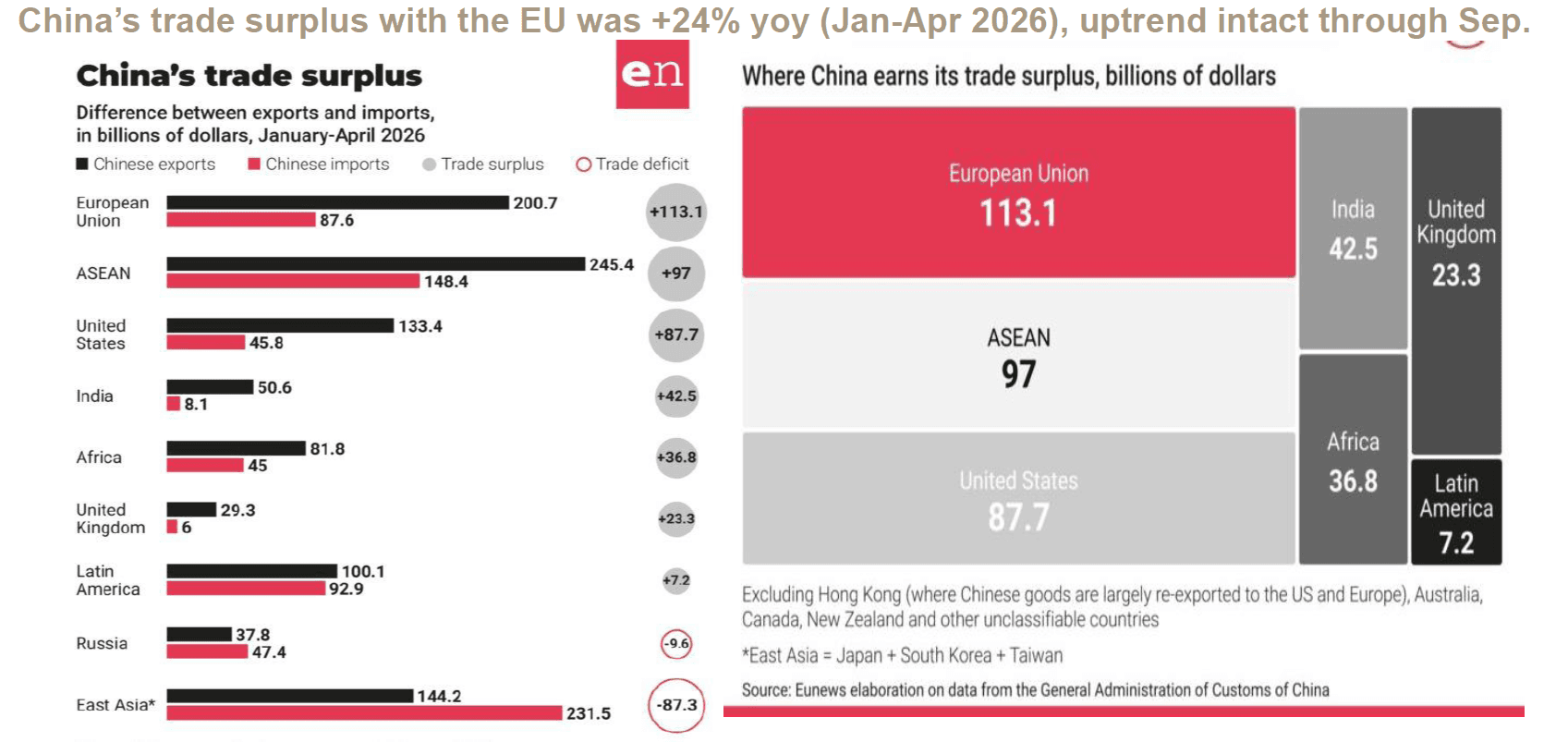
The Economist recently featured an article titled “How Europe should deal with the new China shock”, which aligns with our China Export Shock 2.0 theme. We’d like to share a few key takeaways from this piece. Hope you find them useful.
- Europe faces a “second China shock.” Increasingly competitive Chinese exports, from EVs and machinery to solar panels and wind turbines, are putting growing pressure on European manufacturing, particularly Germany’s industrial base.
- The trade imbalance has become much larger. China’s trade surplus with the EU has risen from roughly 0.6% of its GDP in 2000 to 2% today, equivalent to nearly EUR 1bn a day. France and Germany are consequently converging on a tougher approach toward China.
- Europe remains heavily dependent on Chinese supply chains. Beyond rare earths, pharmaceutical supply chains are vulnerable: over 70% of precursors for amoxicillin come from China. This dependence weakens Europe’s position in any trade confrontation.
- But the dependence goes both ways. China needs European demand as US tariffs and intense domestic competition pressure Chinese exporters. China also relies on Europe for critical products including Dutch chipmaking equipment and aircraft parts.
- Tariffs alone are not the answer. The article argues that Europe’s best defence is to diversify supply chains and improve its own industrial competitiveness, including deeper trade ties with resource-rich partners such as Brazil and Canada. Only then will tougher trade measures become a credible deterrent.
Our Take
There is perhaps not much new in the article, yet it reinforces the global impact of our China Export Shock 2.0 – referring to the sustained surge and structural upgrade of Chinese exports, as Beijing moves from low-end manufactured goods into advanced manufacturing and high-tech products,
- Trade pressures inevitable amid China’s export success. Global manufacturing may be a zero-sum game. And China’s gain could become someone else’s loss. We have seen EU-China trade tensions steadily building, as the European Commission (EC) launched a new “import barometer” to measure sustained import pressures, with Chinese EVs remaining the biggest trade flashpoint. Meanwhile, the US has kept its existing Section 301 trade measures against China in place, despite an extension of their trade truce until January 2027.
- China’s manufacturing edge is equally inevitable. This is structural, not cyclical. Our research has long argued that China’s export competitiveness goes well beyond favourable policy, extending to cost efficiency, world-class infrastructure, deep and localised supply chains and a sizable domestic market to support initial growth. This makes China Export Shock 2.0 much harder for competitors such as Europe to counter simply through tariffs or protectionism.
- The competitive impact extends well beyond Europe. Our previous research argued that China Export Shock 2.0 is also challenging traditional Asian champions such as Japan, Korea and Taiwan, particularly as China moves further into advanced manufacturing and high-tech industries. The next battleground is increasingly AI – now the ultimate measure for a country’s competitiveness. Check out what Nvidia CEO Jensen Huang recently said about China’s manufacturing advantage in the context of AI.
- Protectionism does not invalidate our investment theme. The investment implication from our earlier work has been to focus on companies benefiting from China’s structural manufacturing and export advantages. Our May research highlighted CATL, Geely Auto, Haier and Weichai Power as stock ideas under China Export Shock 2.0, while also identifying Tencent, Alibaba and SF Holdings on the bond side. That said, China trade risk is real, and Europe’s policy response warrants close monitoring, given that the EU remains the world’s second largest economy and the No. 2 trading partner for China.
With our series of Wealth Flash reports on China Export Shock 2.0, we hope you are convinced by now that China’s manufacturing edge is here to stay. However, we also noted that this structural change is not without risk. Here is an update on how Europe is responding to China’s growing export impact.
CIO Summary
- Trade tensions inevitable amid China Export Shock 2.0. Global manufacturing may be a zero-sum game, where China’s gain can become someone else’s loss. Policy pushback is already visible in Europe and the US, from tighter EU import monitoring to continued US trade measures against China.
- China’s manufacturing edge is structural, not cyclical. China Export Shock 2.0 goes beyond supportive policy. Its edge is driven by cost efficiency, infrastructure, deep and localized supply chains, and a large domestic market, as Beijing moves from traditional manufacturing into advanced manufacturing and high-tech industries. The next battleground is increasingly AI.
- Protectionism does not invalidate the investment theme, but trade risk is real. Our China Export Shock 2.0 thesis remains focused on companies benefiting from China’s structural manufacturing and export advantages. However, Europe’s response warrants close monitoring given the EU’s economic scale and importance to Chinese trade.
The Economist recently featured an article titled “How Europe should deal with the new China shock”, which aligns with our China Export Shock 2.0 theme. We’d like to share a few key takeaways from this piece. Hope you find them useful.
- Europe faces a “second China shock.” Increasingly competitive Chinese exports, from EVs and machinery to solar panels and wind turbines, are putting growing pressure on European manufacturing, particularly Germany’s industrial base.
- The trade imbalance has become much larger. China’s trade surplus with the EU has risen from roughly 0.6% of its GDP in 2000 to 2% today, equivalent to nearly EUR 1bn a day. France and Germany are consequently converging on a tougher approach toward China.
- Europe remains heavily dependent on Chinese supply chains. Beyond rare earths, pharmaceutical supply chains are vulnerable: over 70% of precursors for amoxicillin come from China. This dependence weakens Europe’s position in any trade confrontation.
- But the dependence goes both ways. China needs European demand as US tariffs and intense domestic competition pressure Chinese exporters. China also relies on Europe for critical products including Dutch chipmaking equipment and aircraft parts.
- Tariffs alone are not the answer. The article argues that Europe’s best defence is to diversify supply chains and improve its own industrial competitiveness, including deeper trade ties with resource-rich partners such as Brazil and Canada. Only then will tougher trade measures become a credible deterrent.
Our Take
There is perhaps not much new in the article, yet it reinforces the global impact of our China Export Shock 2.0 – referring to the sustained surge and structural upgrade of Chinese exports, as Beijing moves from low-end manufactured goods into advanced manufacturing and high-tech products,
- Trade pressures inevitable amid China’s export success. Global manufacturing may be a zero-sum game. And China’s gain could become someone else’s loss. We have seen EU-China trade tensions steadily building, as the European Commission (EC) launched a new “import barometer” to measure sustained import pressures, with Chinese EVs remaining the biggest trade flashpoint. Meanwhile, the US has kept its existing Section 301 trade measures against China in place, despite an extension of their trade truce until January 2027.
- China’s manufacturing edge is equally inevitable. This is structural, not cyclical. Our research has long argued that China’s export competitiveness goes well beyond favourable policy, extending to cost efficiency, world-class infrastructure, deep and localised supply chains and a sizable domestic market to support initial growth. This makes China Export Shock 2.0 much harder for competitors such as Europe to counter simply through tariffs or protectionism.
- The competitive impact extends well beyond Europe. Our previous research argued that China Export Shock 2.0 is also challenging traditional Asian champions such as Japan, Korea and Taiwan, particularly as China moves further into advanced manufacturing and high-tech industries. The next battleground is increasingly AI – now the ultimate measure for a country’s competitiveness. Check out what Nvidia CEO Jensen Huang recently said about China’s manufacturing advantage in the context of AI.
- Protectionism does not invalidate our investment theme. The investment implication from our earlier work has been to focus on companies benefiting from China’s structural manufacturing and export advantages. Our May research highlighted CATL, Geely Auto, Haier and Weichai Power as stock ideas under China Export Shock 2.0, while also identifying Tencent, Alibaba and SF Holdings on the bond side. That said, China trade risk is real, and Europe’s policy response warrants close monitoring, given that the EU remains the world’s second largest economy and the No. 2 trading partner for China.
Disclosures and disclaimers
This report is provided subject to, and must be read together with, the full Disclosures / Disclaimers available at this link, which are incorporated by reference into this report. In particular, this report is intended for general circulation and informational purposes only and does not constitute personal investment advice or a recommendation to buy or sell any investment product or security. You should independently evaluate the information and, where necessary, seek advice from a qualified financial adviser regarding the suitability of any investment. Analyst certifications required under applicable regulations, including SEC Regulation AC (where relevant), are included in this report. By accessing, receiving or using this report, you acknowledge that you have read, understood and agreed to be bound by the Disclosures / Disclaimers, as may be amended, supplemented or updated from time to time.


