

Wealth Daily
AI Cash Costs Weigh on Tech as Growth Stays Firm
Today’s Must-Know News
Overnight Markets
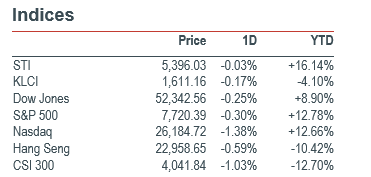
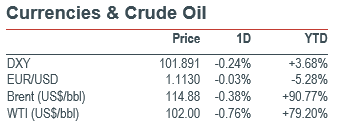
Market Movers: At the 29 October close, the S&P 500 fell 0.30%. Alphabet (GOOGL US) lost 12.64% in its first cash reaction to 3Q results: revenue rose 25% YoY to US$127.6bn, but free cash flow was negative US$9.07bn. After the U.S. close, Amazon (AMZN US) fell 5.66% by 06:07 SGT after its US$240–247bn holiday-quarter sales forecast left the midpoint below consensus. Intel (INTC US) dropped 20.22% by 05:45 SGT after forecasting 4Q sales of US$15–16bn, below estimates, as an Israeli plant disruption adds to weak PC demand. The reactions sharpen scrutiny of cash returns and execution. (Alphabet / Reuters / Intel / Reuters / Market data / Market data / Market data / J.P. Morgan) Alphabet (GOOGL US) and Amazon (AMZN US) are our Core Recommendations.
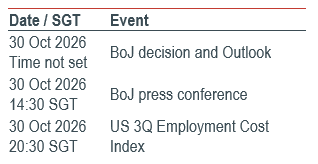
Macro: U.S. 3Q GDP grew 3.40% annualised, up from 2.20%, while September headline PCE inflation reached 3.60% YoY and core inflation 3.10%. The ECB held its deposit rate at 2.50%; Christine Lagarde will step down on 7 February 2027. These developments leave inflation and policy continuity in focus. The forthcoming BoJ decision is expected to hold rates at 1.25%. Watch its inflation projections and December tightening signals: unexpectedly hawkish guidance could strengthen the yen and pressure rate-sensitive assets. Governor Ueda’s press conference is at 14:30 SGT. (BEA / BEA / ECB / ECB / BoJ / Reuters)
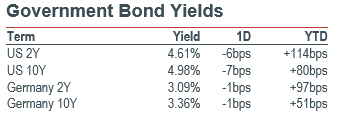
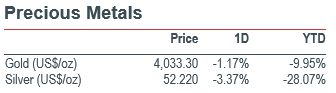
FICC: The U.S. 10-year Treasury par yield fell 7bps to 4.98%. December silver was down 3.37% at US$52.220/oz in late U.S. trading. Divergent moves keep portfolio sensitivity in focus. (U.S. Treasury / Market data)
AI
• Alphabet cash burn drives reassessment. Alphabet (GOOGL US) shares closed 12.64% lower after earnings. Cloud revenue rose 103% YoY to US$30.7bn, but quarterly free cash flow was negative US$9.07bn. Search growth of 12% missed the 14.7% consensus, highlighting pressure on the advertising engine financing AI investment despite the rapid expansion in cloud computing. (Alphabet / Reuters / Market data) Alphabet (GOOGL US) is our Core Recommendation.
• Amazon cloud growth cannot offset cash concerns. Amazon (AMZN US) shares fell 5.66% after hours by 06:07 SGT. AWS revenue rose 39% YoY to US$46.0bn, but trailing annual free cash flow swung to negative US$42.4bn from positive US$14.8bn. Holiday-quarter sales guidance of US$240–247bn brackets US$244.51bn consensus; funding demands constrain otherwise strong cloud growth. (Amazon / Reuters / Market data) Amazon (AMZN US) is our Core Recommendation.
• Microsoft returns to bond market. Reuters reported Microsoft (MSFT US) plans to raise about US$25bn in its first US investment-grade bond sale in over nine years. The proposed offering spans up to ten tranches; final size remains variable. Quarterly free cash flow of US$18.6bn and Azure growth of 48% YoY indicate comparatively resilient internal funding. (Reuters / Reuters) Microsoft (MSFT US) is our Investment Opportunity.
• Intel weak outlook exposes supply and PC risks. Intel (INTC US) shares slumped 20.22% after hours by 05:45 SGT. Fourth-quarter revenue guidance of US$15–16bn missed US$17.07bn consensus, despite quarterly revenue rising 21% YoY to US$16.51bn. An Israeli factory explosion and weakening PC demand constrain the outlook; strong server demand cannot eliminate manufacturing or consumer-cycle exposure. (Intel / Reuters / Market data)
Americas
• Eli Lilly lifts its sales outlook. Eli Lilly (LLY US) revenue rose 39% YoY to US$24.4bn, led by Mounjaro and Zepbound; shares gained 6.63%. Management raised the annual revenue midpoint by US$5.5bn to US$91–92bn. Approximately US$900m of quarterly benefits, including milestones and rebate adjustments, temper the underlying run rate; sustained volume growth remains the key test. (Eli Lilly / Market data) Eli Lilly (LLY US) is our Core Recommendation.
• Caterpillar backlog fails to satisfy expectations. Caterpillar (CAT US) shares fell 9.25% despite quarterly revenue rising 17% YoY to US$20.7bn and adjusted EPS increasing to US$7.20 from US$4.95. Annual sales-growth guidance remained in the mid-to-high teens. Capacity expansion limits conversion of data-centre power demand into deliveries, leaving execution and tariff costs central to returns. (Caterpillar / Reuters / Market data)
• ServiceNow forward growth signal overwhelms earnings. ServiceNow (NOW US) shares plunged 26.95% after fourth-quarter current remaining performance-obligation growth guidance of 18.5% missed 19.4% consensus. Subscription revenue rose 21% YoY to US$3.99bn. Investors remain sensitive to future contracted growth as AI competition intensifies, despite management raising its annual AI contract-value target to US$1.7bn. (ServiceNow / Yahoo Finance / Market data)
• Fortinet services outlook unsettles cybersecurity investors. Fortinet (FTNT US) shares dropped 20.09% after annual service-revenue guidance fell to US$5.15–5.17bn from US$5.18–5.22bn. Quarterly revenue grew 20% YoY to US$2.08bn and billings increased 29% to US$2.34bn. Converting hardware demand into recurring services remains the key test, making growth quality more important than aggregate bookings strength. (Fortinet / Yahoo Finance / Market data)
• DoorDash agrees to acquire Instacart. DoorDash (DASH US) reported the definitive deal values Instacart’s equity at approximately US$17bn, or US$65 per share, with at least 75% cash consideration. The price represents a 26% premium to the unaffected reference close. Combining logistics with grocery technology expands scale, but shareholder and regulatory approvals leave execution and competition risks. (DoorDash / BusinessWire)
• Linde electronics demand supports earnings. Linde (LIN US) reported that quarterly sales rose 9% YoY to US$9.40bn and adjusted EPS increased 9% to US$4.59. Underlying growth comprised 3% pricing and 2% volume, with electronics among stronger markets. Annual adjusted EPS guidance of US$17.82–17.92 and US$7.9bn gas-project backlog support visibility, although capital intensity and execution constrain returns. (Linde / EQS)
• Merck broader portfolio supports its outlook. Merck (MRK US) reported the revenue rose 5% YoY to US$18.1bn, with Keytruda-related sales up 6% to US$8.6bn and Winrevair up 93% to US$694m. Adjusted EPS fell 3% to US$2.49, including a licensing charge. The raised US$66.8–67.3bn annual sales range supports commercial progress, although oncology dependence makes diversification essential. (Merck)
• Twilio selloff accompanies a slower growth outlook. Twilio (TWLO US) reported the revenue grew 20% YoY to US$1.56bn, with 16% organic growth, but fourth-quarter organic guidance slows to 11–12%. Shares fell 16.39% after hours by 06:03 SGT. Expectations remain demanding for communications software despite management raising its full-year reported revenue-growth outlook to 20%. (Twilio / Market data)
• Bristol Myers Squibb raises sales guidance; charges weigh. Bristol Myers Squibb (BMY US) posted the quarterly revenue rose 7% YoY to US$13.1bn, with newer medicines growing 12%. Management lifted annual revenue guidance to US$49.75–50.25bn but cut adjusted EPS to US$6.35–6.55 from US$6.75–7.00 after an acquisition-related charge. Commercial momentum supports pipeline renewal, although investors must separate operating progress from acquisition costs. (Reuters)
• Starbucks recovery brings stronger profit. Starbucks (SBUX US) reported that fiscal fourth-quarter comparable sales grew 7.2%, while revenue fell 4% YoY to US$9.1bn following the China joint-venture conversion. Adjusted EPS rose 54% to US$0.80. Fiscal 2027 guidance calls for US$3.15–3.25 adjusted EPS and roughly 1% lower revenue, separating improving store economics from ownership-related accounting changes. (Starbucks / BusinessWire / Reuters)
• ADT agrees to a Thrive take-private. ADT (ADT US) shareholders would receive US$10 cash per share, a 45.6% premium to the unaffected close. The deal values equity at US$7.6bn and the enterprise at US$15.3bn. Closing is expected in first-quarter 2027, subject to approvals. A 30-day solicitation period allows competing bids; completion risk remains. (ADT / GlobeNewswire)
• Altria increases shareholder returns. Altria (MO US) revenue excluding excise taxes rose 3.6% YoY to US$5.44bn and adjusted EPS advanced 4.8% to US$1.52. Management raised annual adjusted EPS guidance to US$5.66–5.74; the board expanded buyback authority by US$1bn. Cash generation supports distributions, but guidance assumes NJOY ACE stays off the market this year. (Altria)
Greater China
• BYD's quarterly rebound faces working-capital demands. BYD (1211.HK) reported after-market Q3 attributable profit of RMB10.02bn, up 28.1% YoY, on revenue growth of 13.6% to RMB221.49bn. Nine-month profit remained 4.2% lower, while inventories were 60.1% above year-end. The quarterly recovery improves momentum, but expanding overseas operations make cash conversion an important test. (Company / Reuters)
• Midea's profit growth needs an accounting distinction. Midea Group (0300.HK) posted after-market Q3 attributable profit of RMB14.95bn, up 25.9% YoY, despite revenue falling 4.1%. Profit excluding non-recurring items fell 15.7%; foreign-exchange losses and offsetting derivative gains receive different classifications. Nine-month operating cash flow fell 29.6%, making cash conversion a useful earnings-quality check. (Company) Midea Group (0300.HK) is our Core Recommendation.
• Sinopec's refining recovery lifts profit and cash generation. Sinopec (0386.HK) reported after-market Q3 attributable profit under international accounting standards of RMB13.60bn, up 63.6% YoY. Revenue rose 9.3% to RMB769.74bn; nine-month operating cash flow increased 41.1% to RMB161.99bn. Refining and chemical margins supported earnings, leaving product spreads and demand central to sustained returns. (Company)
• Geely's richer sales mix supports underlying profitability. Geely Automobile (0175.HK) reported Q3 attributable profit of RMB4.84bn, up 28% YoY on restated comparatives. Revenue rose 10% to RMB98.96bn, ahead of 7% vehicle-volume growth. Shares fell 4.37% despite the midday release. Export growth and higher-value products support margins, although currency effects complicate underlying comparisons. (Company / Gasgoo / Market data) Geely Automobile (0175.HK) is our Core Recommendation.
• Unicom's computing growth cannot offset earnings pressure. China Unicom (0762.HK) disclosed after-market nine-month attributable profit of RMB13.28bn, down 33.60% YoY, despite revenue increasing 0.60% to RMB294.65bn. Computing revenue grew 12.20%. Employee-benefit expenses rose to RMB50.83bn from RMB42.66bn. Digital growth needs to generate sufficient returns to absorb the group's rising cost base. (Company)
Asia ex. China
• Samsung's record profit leaves payout questions. Samsung Electronics (005930.KS) fell 4.13% after detailed Q3 results confirmed operating profit of KRW107.4tn, up 783% YoY. Full-year capital spending is expected to reach KRW84.4tn; final capital-return plans wait until January 2027. Strong memory demand backs investment, but distribution timing remains uncertain. (Company / Yonhap / Reuters / Market data)
• Hitachi's sell-off contrasts with stronger underlying earnings. Hitachi (6501.T) fell 9.77% in its first cash session after prior-evening results. Q2 net profit fell 19% YoY to ¥227.1bn, chiefly reflecting a prior-year disposal gain. Management raised full-year profit guidance to ¥920bn from ¥900bn. Delivering the improved forecast remains the key investment test. (Company / Investing.com / Market data)
• Keppel's recurring businesses offset legacy-asset pressure. Keppel (BN4.SI) said nine-month New Keppel profit rose over 20% YoY, excluding non-core assets and discontinued operations; overall profit fell 40%. Announced asset monetisation reached S$3.7bn versus a S$2–3bn annual target. Recurring growth supports ordinary dividends, while completed disposals determine capacity for special distributions. (Company / RTTNews)
EMEA and Others
• Shell channels strong refining cash flow into buybacks. Shell (SHEL.L) reported Q3 adjusted earnings of US$10.81bn. Free cash flow reached US$16.3bn, up 63% YoY, and it announced US$5bn of buybacks over three months. Shares rose 2.06%. Record refining margins and gas earnings support distributions, while acquisitions and capital spending compete for cash. (Company / Reuters / Market data)
• TotalEnergies balances exceptional earnings with measured distributions. TotalEnergies (TTE.PA) reported Q3 adjusted net income of US$9.10bn, up 129% YoY, and cash flow of US$12.3bn. It maintained a €0.90 interim dividend and planned US$2.5bn buybacks in each of Q4 and Q1. Cash generation reinforces distributions, while normalising energy margins remain the principal sensitivity. (Company / Company / Reuters)
• Airbus keeps delivery targets despite working-capital strain. Airbus (AIR.PA) rose 2.30% in its first cash session after results. Nine-month revenue increased 7% YoY to €50.6bn and adjusted EBIT rose 8.4% to €4.50bn. Guidance held, but free cash outflow before customer financing widened to €1.27bn from €0.91bn. Back-loaded deliveries determine cash conversion. (Company / Reuters / Market data)
• BBVA's strong lending growth meets capital scrutiny. BBVA (BBVA.MC) fell 2.58% after results. Nine-month attributable profit rose 13.6% YoY in current euros to €9.07bn; lending grew 20.4% in constant euros. Return on tangible equity reached 22%, with CET1 capital at 12.21%. Strong profitability supports distributions, but loan growth makes capital generation critical. (Company / Reuters / Market data)
• STMicro's recovery broadens beyond traditional chip demand. STMicroelectronics (STM US ADR) reported Q3 revenue of US$3.76bn, up 17.9% YoY, and adjusted operating income of US$429m, up 98%. Q4 revenue midpoint of US$4.15bn implies 24.7% annual growth. AI data centres and satellite communications supplement the recovery, but capacity expansion needs durable customer demand. (Company / Reuters)
• Volkswagen's write-downs expose pressure on profitability. Volkswagen (VOW3.DE) reported a Q3 after-tax loss of €5.82bn versus €1.07bn a year earlier; revenue fell 6.3% to €75.28bn. Nine-month special charges included €6.4bn of Porsche goodwill impairment. The 3.8% operating margin before special items underlines why its €31bn cost programme must also restore underlying competitiveness. (Company)
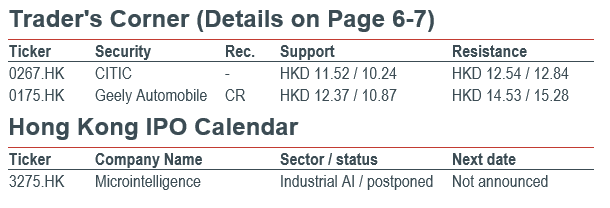
Traders' Corner
Our Technical View
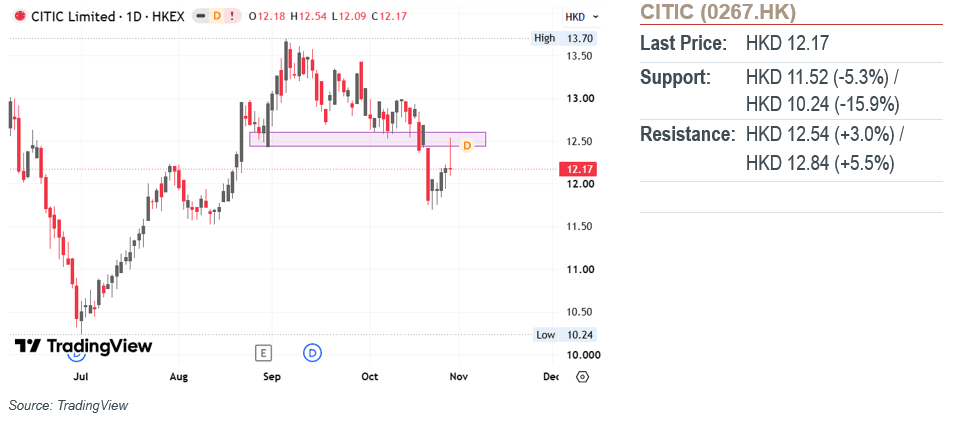
Price encountered a downside rejection upon retesting its support-turned-resistance zone, marked by the printing of a Doji candlestick pattern.
The RSI is in bearish territory and continues to slope downward with negative velocity.
As long as price remains capped beneath this defended resistance, we see continued downward expansion toward lower support.
Our Technical View
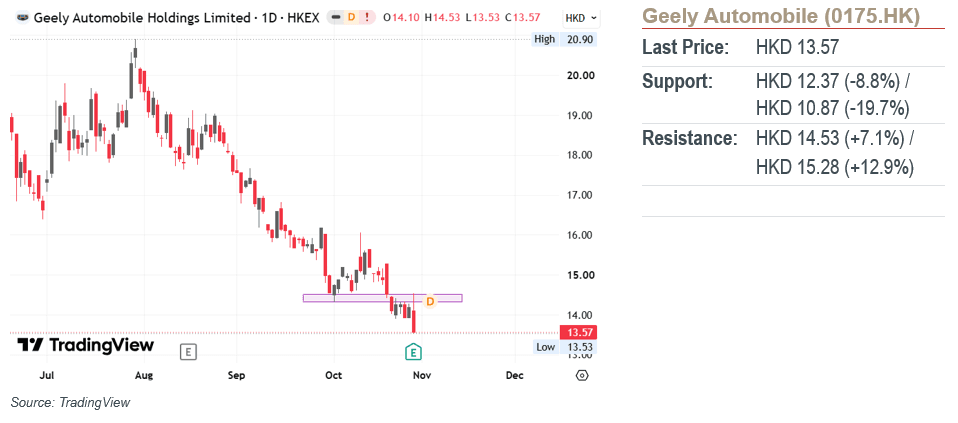
Price was rejected at its support-turned-resistance zone.
The RSI is falling sharply and approaching oversold parameters with strong negative velocity.
As long as price remains suppressed beneath this converted resistance, we see continued downward expansion toward lower support.
Market Movers: At the 29 October close, the S&P 500 fell 0.30%. Alphabet (GOOGL US) lost 12.64% in its first cash reaction to 3Q results: revenue rose 25% YoY to US$127.6bn, but free cash flow was negative US$9.07bn. After the U.S. close, Amazon (AMZN US) fell 5.66% by 06:07 SGT after its US$240–247bn holiday-quarter sales forecast left the midpoint below consensus. Intel (INTC US) dropped 20.22% by 05:45 SGT after forecasting 4Q sales of US$15–16bn, below estimates, as an Israeli plant disruption adds to weak PC demand. The reactions sharpen scrutiny of cash returns and execution. (Alphabet / Reuters / Intel / Reuters / Market data / Market data / Market data / J.P. Morgan) Alphabet (GOOGL US) and Amazon (AMZN US) are our Core Recommendations.
Macro: U.S. 3Q GDP grew 3.40% annualised, up from 2.20%, while September headline PCE inflation reached 3.60% YoY and core inflation 3.10%. The ECB held its deposit rate at 2.50%; Christine Lagarde will step down on 7 February 2027. These developments leave inflation and policy continuity in focus. The forthcoming BoJ decision is expected to hold rates at 1.25%. Watch its inflation projections and December tightening signals: unexpectedly hawkish guidance could strengthen the yen and pressure rate-sensitive assets. Governor Ueda’s press conference is at 14:30 SGT. (BEA / BEA / ECB / ECB / BoJ / Reuters)
FICC: The U.S. 10-year Treasury par yield fell 7bps to 4.98%. December silver was down 3.37% at US$52.220/oz in late U.S. trading. Divergent moves keep portfolio sensitivity in focus. (U.S. Treasury / Market data)
AI
• Alphabet cash burn drives reassessment. Alphabet (GOOGL US) shares closed 12.64% lower after earnings. Cloud revenue rose 103% YoY to US$30.7bn, but quarterly free cash flow was negative US$9.07bn. Search growth of 12% missed the 14.7% consensus, highlighting pressure on the advertising engine financing AI investment despite the rapid expansion in cloud computing. (Alphabet / Reuters / Market data) Alphabet (GOOGL US) is our Core Recommendation.
• Amazon cloud growth cannot offset cash concerns. Amazon (AMZN US) shares fell 5.66% after hours by 06:07 SGT. AWS revenue rose 39% YoY to US$46.0bn, but trailing annual free cash flow swung to negative US$42.4bn from positive US$14.8bn. Holiday-quarter sales guidance of US$240–247bn brackets US$244.51bn consensus; funding demands constrain otherwise strong cloud growth. (Amazon / Reuters / Market data) Amazon (AMZN US) is our Core Recommendation.
• Microsoft returns to bond market. Reuters reported Microsoft (MSFT US) plans to raise about US$25bn in its first US investment-grade bond sale in over nine years. The proposed offering spans up to ten tranches; final size remains variable. Quarterly free cash flow of US$18.6bn and Azure growth of 48% YoY indicate comparatively resilient internal funding. (Reuters / Reuters) Microsoft (MSFT US) is our Investment Opportunity.
• Intel weak outlook exposes supply and PC risks. Intel (INTC US) shares slumped 20.22% after hours by 05:45 SGT. Fourth-quarter revenue guidance of US$15–16bn missed US$17.07bn consensus, despite quarterly revenue rising 21% YoY to US$16.51bn. An Israeli factory explosion and weakening PC demand constrain the outlook; strong server demand cannot eliminate manufacturing or consumer-cycle exposure. (Intel / Reuters / Market data)
Americas
• Eli Lilly lifts its sales outlook. Eli Lilly (LLY US) revenue rose 39% YoY to US$24.4bn, led by Mounjaro and Zepbound; shares gained 6.63%. Management raised the annual revenue midpoint by US$5.5bn to US$91–92bn. Approximately US$900m of quarterly benefits, including milestones and rebate adjustments, temper the underlying run rate; sustained volume growth remains the key test. (Eli Lilly / Market data) Eli Lilly (LLY US) is our Core Recommendation.
• Caterpillar backlog fails to satisfy expectations. Caterpillar (CAT US) shares fell 9.25% despite quarterly revenue rising 17% YoY to US$20.7bn and adjusted EPS increasing to US$7.20 from US$4.95. Annual sales-growth guidance remained in the mid-to-high teens. Capacity expansion limits conversion of data-centre power demand into deliveries, leaving execution and tariff costs central to returns. (Caterpillar / Reuters / Market data)
• ServiceNow forward growth signal overwhelms earnings. ServiceNow (NOW US) shares plunged 26.95% after fourth-quarter current remaining performance-obligation growth guidance of 18.5% missed 19.4% consensus. Subscription revenue rose 21% YoY to US$3.99bn. Investors remain sensitive to future contracted growth as AI competition intensifies, despite management raising its annual AI contract-value target to US$1.7bn. (ServiceNow / Yahoo Finance / Market data)
• Fortinet services outlook unsettles cybersecurity investors. Fortinet (FTNT US) shares dropped 20.09% after annual service-revenue guidance fell to US$5.15–5.17bn from US$5.18–5.22bn. Quarterly revenue grew 20% YoY to US$2.08bn and billings increased 29% to US$2.34bn. Converting hardware demand into recurring services remains the key test, making growth quality more important than aggregate bookings strength. (Fortinet / Yahoo Finance / Market data)
• DoorDash agrees to acquire Instacart. DoorDash (DASH US) reported the definitive deal values Instacart’s equity at approximately US$17bn, or US$65 per share, with at least 75% cash consideration. The price represents a 26% premium to the unaffected reference close. Combining logistics with grocery technology expands scale, but shareholder and regulatory approvals leave execution and competition risks. (DoorDash / BusinessWire)
• Linde electronics demand supports earnings. Linde (LIN US) reported that quarterly sales rose 9% YoY to US$9.40bn and adjusted EPS increased 9% to US$4.59. Underlying growth comprised 3% pricing and 2% volume, with electronics among stronger markets. Annual adjusted EPS guidance of US$17.82–17.92 and US$7.9bn gas-project backlog support visibility, although capital intensity and execution constrain returns. (Linde / EQS)
• Merck broader portfolio supports its outlook. Merck (MRK US) reported the revenue rose 5% YoY to US$18.1bn, with Keytruda-related sales up 6% to US$8.6bn and Winrevair up 93% to US$694m. Adjusted EPS fell 3% to US$2.49, including a licensing charge. The raised US$66.8–67.3bn annual sales range supports commercial progress, although oncology dependence makes diversification essential. (Merck)
• Twilio selloff accompanies a slower growth outlook. Twilio (TWLO US) reported the revenue grew 20% YoY to US$1.56bn, with 16% organic growth, but fourth-quarter organic guidance slows to 11–12%. Shares fell 16.39% after hours by 06:03 SGT. Expectations remain demanding for communications software despite management raising its full-year reported revenue-growth outlook to 20%. (Twilio / Market data)
• Bristol Myers Squibb raises sales guidance; charges weigh. Bristol Myers Squibb (BMY US) posted the quarterly revenue rose 7% YoY to US$13.1bn, with newer medicines growing 12%. Management lifted annual revenue guidance to US$49.75–50.25bn but cut adjusted EPS to US$6.35–6.55 from US$6.75–7.00 after an acquisition-related charge. Commercial momentum supports pipeline renewal, although investors must separate operating progress from acquisition costs. (Reuters)
• Starbucks recovery brings stronger profit. Starbucks (SBUX US) reported that fiscal fourth-quarter comparable sales grew 7.2%, while revenue fell 4% YoY to US$9.1bn following the China joint-venture conversion. Adjusted EPS rose 54% to US$0.80. Fiscal 2027 guidance calls for US$3.15–3.25 adjusted EPS and roughly 1% lower revenue, separating improving store economics from ownership-related accounting changes. (Starbucks / BusinessWire / Reuters)
• ADT agrees to a Thrive take-private. ADT (ADT US) shareholders would receive US$10 cash per share, a 45.6% premium to the unaffected close. The deal values equity at US$7.6bn and the enterprise at US$15.3bn. Closing is expected in first-quarter 2027, subject to approvals. A 30-day solicitation period allows competing bids; completion risk remains. (ADT / GlobeNewswire)
• Altria increases shareholder returns. Altria (MO US) revenue excluding excise taxes rose 3.6% YoY to US$5.44bn and adjusted EPS advanced 4.8% to US$1.52. Management raised annual adjusted EPS guidance to US$5.66–5.74; the board expanded buyback authority by US$1bn. Cash generation supports distributions, but guidance assumes NJOY ACE stays off the market this year. (Altria)
Greater China
• BYD's quarterly rebound faces working-capital demands. BYD (1211.HK) reported after-market Q3 attributable profit of RMB10.02bn, up 28.1% YoY, on revenue growth of 13.6% to RMB221.49bn. Nine-month profit remained 4.2% lower, while inventories were 60.1% above year-end. The quarterly recovery improves momentum, but expanding overseas operations make cash conversion an important test. (Company / Reuters)
• Midea's profit growth needs an accounting distinction. Midea Group (0300.HK) posted after-market Q3 attributable profit of RMB14.95bn, up 25.9% YoY, despite revenue falling 4.1%. Profit excluding non-recurring items fell 15.7%; foreign-exchange losses and offsetting derivative gains receive different classifications. Nine-month operating cash flow fell 29.6%, making cash conversion a useful earnings-quality check. (Company) Midea Group (0300.HK) is our Core Recommendation.
• Sinopec's refining recovery lifts profit and cash generation. Sinopec (0386.HK) reported after-market Q3 attributable profit under international accounting standards of RMB13.60bn, up 63.6% YoY. Revenue rose 9.3% to RMB769.74bn; nine-month operating cash flow increased 41.1% to RMB161.99bn. Refining and chemical margins supported earnings, leaving product spreads and demand central to sustained returns. (Company)
• Geely's richer sales mix supports underlying profitability. Geely Automobile (0175.HK) reported Q3 attributable profit of RMB4.84bn, up 28% YoY on restated comparatives. Revenue rose 10% to RMB98.96bn, ahead of 7% vehicle-volume growth. Shares fell 4.37% despite the midday release. Export growth and higher-value products support margins, although currency effects complicate underlying comparisons. (Company / Gasgoo / Market data) Geely Automobile (0175.HK) is our Core Recommendation.
• Unicom's computing growth cannot offset earnings pressure. China Unicom (0762.HK) disclosed after-market nine-month attributable profit of RMB13.28bn, down 33.60% YoY, despite revenue increasing 0.60% to RMB294.65bn. Computing revenue grew 12.20%. Employee-benefit expenses rose to RMB50.83bn from RMB42.66bn. Digital growth needs to generate sufficient returns to absorb the group's rising cost base. (Company)
Asia ex. China
• Samsung's record profit leaves payout questions. Samsung Electronics (005930.KS) fell 4.13% after detailed Q3 results confirmed operating profit of KRW107.4tn, up 783% YoY. Full-year capital spending is expected to reach KRW84.4tn; final capital-return plans wait until January 2027. Strong memory demand backs investment, but distribution timing remains uncertain. (Company / Yonhap / Reuters / Market data)
• Hitachi's sell-off contrasts with stronger underlying earnings. Hitachi (6501.T) fell 9.77% in its first cash session after prior-evening results. Q2 net profit fell 19% YoY to ¥227.1bn, chiefly reflecting a prior-year disposal gain. Management raised full-year profit guidance to ¥920bn from ¥900bn. Delivering the improved forecast remains the key investment test. (Company / Investing.com / Market data)
• Keppel's recurring businesses offset legacy-asset pressure. Keppel (BN4.SI) said nine-month New Keppel profit rose over 20% YoY, excluding non-core assets and discontinued operations; overall profit fell 40%. Announced asset monetisation reached S$3.7bn versus a S$2–3bn annual target. Recurring growth supports ordinary dividends, while completed disposals determine capacity for special distributions. (Company / RTTNews)
EMEA and Others
• Shell channels strong refining cash flow into buybacks. Shell (SHEL.L) reported Q3 adjusted earnings of US$10.81bn. Free cash flow reached US$16.3bn, up 63% YoY, and it announced US$5bn of buybacks over three months. Shares rose 2.06%. Record refining margins and gas earnings support distributions, while acquisitions and capital spending compete for cash. (Company / Reuters / Market data)
• TotalEnergies balances exceptional earnings with measured distributions. TotalEnergies (TTE.PA) reported Q3 adjusted net income of US$9.10bn, up 129% YoY, and cash flow of US$12.3bn. It maintained a €0.90 interim dividend and planned US$2.5bn buybacks in each of Q4 and Q1. Cash generation reinforces distributions, while normalising energy margins remain the principal sensitivity. (Company / Company / Reuters)
• Airbus keeps delivery targets despite working-capital strain. Airbus (AIR.PA) rose 2.30% in its first cash session after results. Nine-month revenue increased 7% YoY to €50.6bn and adjusted EBIT rose 8.4% to €4.50bn. Guidance held, but free cash outflow before customer financing widened to €1.27bn from €0.91bn. Back-loaded deliveries determine cash conversion. (Company / Reuters / Market data)
• BBVA's strong lending growth meets capital scrutiny. BBVA (BBVA.MC) fell 2.58% after results. Nine-month attributable profit rose 13.6% YoY in current euros to €9.07bn; lending grew 20.4% in constant euros. Return on tangible equity reached 22%, with CET1 capital at 12.21%. Strong profitability supports distributions, but loan growth makes capital generation critical. (Company / Reuters / Market data)
• STMicro's recovery broadens beyond traditional chip demand. STMicroelectronics (STM US ADR) reported Q3 revenue of US$3.76bn, up 17.9% YoY, and adjusted operating income of US$429m, up 98%. Q4 revenue midpoint of US$4.15bn implies 24.7% annual growth. AI data centres and satellite communications supplement the recovery, but capacity expansion needs durable customer demand. (Company / Reuters)
• Volkswagen's write-downs expose pressure on profitability. Volkswagen (VOW3.DE) reported a Q3 after-tax loss of €5.82bn versus €1.07bn a year earlier; revenue fell 6.3% to €75.28bn. Nine-month special charges included €6.4bn of Porsche goodwill impairment. The 3.8% operating margin before special items underlines why its €31bn cost programme must also restore underlying competitiveness. (Company)
Traders' Corner
Our Technical View
Price encountered a downside rejection upon retesting its support-turned-resistance zone, marked by the printing of a Doji candlestick pattern.
The RSI is in bearish territory and continues to slope downward with negative velocity.
As long as price remains capped beneath this defended resistance, we see continued downward expansion toward lower support.
Our Technical View
Price was rejected at its support-turned-resistance zone.
The RSI is falling sharply and approaching oversold parameters with strong negative velocity.
As long as price remains suppressed beneath this converted resistance, we see continued downward expansion toward lower support.
Disclosures and disclaimers
This report is provided subject to, and must be read together with, the full Disclosures / Disclaimers available at this link, which are incorporated by reference into this report. In particular, this report is intended for general circulation and informational purposes only and does not constitute personal investment advice or a recommendation to buy or sell any investment product or security. You should independently evaluate the information and, where necessary, seek advice from a qualified financial adviser regarding the suitability of any investment. Analyst certifications required under applicable regulations, including SEC Regulation AC (where relevant), are included in this report. By accessing, receiving or using this report, you acknowledge that you have read, understood and agreed to be bound by the Disclosures / Disclaimers, as may be amended, supplemented or updated from time to time.


