

Wealth Daily
Tech Rebounds as Nvidia Faces Governance Scrutiny
Today’s Must-Know News
Overnight Markets
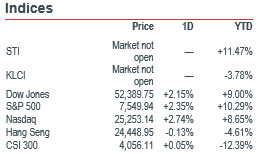
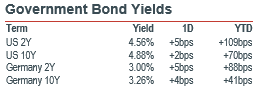
Market Movers: The S&P 500 rose 2.3% and Nasdaq 2.7%, with all 11 S&P sectors advancing. Nvidia (NVDA US) fell 4.3% after its board launched an independent investigation into a reported foreign-intelligence effort targeting its chief executive; directors said they had no reason to believe company secrets were compromised. AMD (AMD US) gained 13.3% following an analyst upgrade. Alphabet (GOOGL US) introduced two TPU systems, expanding its AI infrastructure offering. Japan Tobacco (2914 JP) slumped 16.0% after all seven Russian entities came under temporary administration. Russia represents about 25.0% of its FY26 adjusted operating-profit forecast. (eOption / Nvidia / Google / Company / Market data) Nvidia (NVDA US) and Alphabet (GOOGL US) are our Core Recommendations.
Macro: The New York Fed’s survey left one-year inflation expectations at 3.9%. The perceived chance of rising unemployment reached 45.3%, the highest since April 2020, indicating household caution. (New York Fed)
Geopolitical: China extended its suspension of an additional 24% tariff on US goods for two months from 13:01 SGT today, retaining the 10% levy. Possible replacement US tariffs leave the broader framework uncertain. (Ministry of Finance)
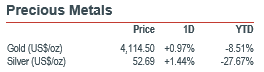
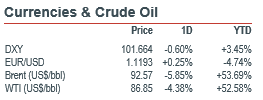
FICC: Brent settled 5.85% lower at US$92.57/bbl and WTI fell 4.38% to US$86.85/bbl as President Trump signalled restraint on Iran if talks progress. Shipping disruptions persist and no agreement was confirmed. Gold gained 0.97% to US$4,114.50/oz. (eOption / Reuters)
AI
• AMD gains as cloud adoption reinforces its AI position. Advanced Micro Devices (AMD US) rallied 13.3% as Oppenheimer upgraded the shares to Outperform with a US$600 target. The broker forecast 135% data-centre revenue growth in 2027. Google also selected EPYC host processors for its new TPU 8tx system. The combination supports a wider AI revenue opportunity, although the earnings assumptions remain forecasts and execution must justify the stronger valuation. (Investing.com / Company / Market data)
• Google broadens its alternatives to GPU infrastructure. Alphabet (GOOGL US) introduced TPU 8tx and 8i Max systems. The 8tx uses AMD EPYC host processors and adds protection for data and model weights in use; 8i Max combines two inference chips in one package, doubling compute, on-chip memory and memory bandwidth. These extensions give cloud customers more options for balancing AI performance, security and deployment cost. (Company) Alphabet (GOOGL US) is our Core Recommendation.
• Microsoft’s supplier review increases pressure on neoclouds. Microsoft (MSFT US) is evaluating a smaller group of specialist cloud suppliers while expanding its own data centres, CNBC reported, citing people familiar with the matter. No decisions had been made on which neocloud partners to drop. The company has worked with six such providers. Greater selectivity raises customer-concentration and funding risks for smaller operators without establishing a collapse in AI demand. (CNBC) Microsoft (MSFT US) is our Investment Opportunity.
• Anthropic increases model speed while widening access. Anthropic launched Claude Fable 5.2 and Mythos 5.2, reporting up to 30% faster performance than their predecessors. Standard API pricing is US$8 per million input tokens and US$40 per million output tokens. Fable is broadly available, while Mythos requires specialist verification. The release intensifies competition over AI capability, operating cost and access to sensitive functionality. (Company)
Americas
• Broadcom rebounds as cloud-software adoption expands. Broadcom (AVGO US) gained 8.8% alongside the wider recovery in AI infrastructure shares. Separately, its VMAPI project entered the Cloud Native Computing Foundation’s Sandbox, enabling virtual-machine management through Kubernetes, while VMware announced 20 new validated partners. The initiative may strengthen VMware’s relevance across mixed cloud environments, although the broad share-price rebound cannot be attributed solely to this software announcement. (Company / Benzinga / Market data) Broadcom (AVGO US) is our Core Recommendation.
• FDA labelling action adds scrutiny to obesity treatments. The FDA required all GLP-1 receptor-agonist manufacturers to add warnings about a potential increased risk of NAION, a rare eye condition that can cause permanent vision loss. The class-wide action is relevant to Lilly’s diabetes and obesity franchise. It raises monitoring and disclosure obligations, while the notice does not quantify a resulting commercial impact or establish a sales forecast. (FDA) Eli Lilly (LLY US) is our Core Recommendation.
• Berkshire increases buybacks despite softer insurance earnings. Berkshire Hathaway (BRK.B US) repurchased US$9.6bn of shares during the third quarter, bringing nine-month purchases to US$14.4bn. Operating earnings declined 5.8% YoY to US$12.7bn, with insurance underwriting profit down 42.9%. Capital returns provide support, but the weaker underwriting result shows that the conglomerate’s defensive appeal still depends on pricing discipline and insurance-loss trends. (Company / Market data) Berkshire Hathaway (BRK.B US) is our Core Recommendation.
• Constellation earnings strengthen the power-demand case. Constellation Energy (CEG US) rose 10.5% after third-quarter adjusted operating EPS reached US$5.06, up 66.4% YoY from US$3.04, including the contribution of acquired Calpine. Management raised the midpoint and narrowed full-year guidance to US$12.50–12.80. The stronger outlook supports the investment case for scarce generation capacity, although acquisition effects mean the reported earnings growth should not be read as purely organic. (Company / Market data)
• NRG recycles generation assets into buybacks and debt reduction. NRG Energy (NRG US) rose 10.3% after announcing a US$4bn sale of six gas-generation assets to LS Power, representing 4.9GW of capacity. The price implies eight times projected 2027 adjusted EBITDA. Proceeds support additional repurchases and debt reduction, improving capital flexibility; however, the transaction remains subject to regulatory approval and is targeted to close in the second quarter of 2027. (Company / Market data)
• Occidental debt reduction improves capital-return capacity. Occidental Petroleum (OXY US) reported US$2.8bn of quarterly free cash flow before working capital from continuing operations and reduced principal debt to US$10bn. Production averaged 1.427m barrels of oil equivalent daily, down 2.6% YoY. The stronger balance sheet increases flexibility for shareholder returns, but lower output and sensitivity to realised oil prices remain relevant to the sustainability of cash generation. (Company / Company) Occidental Petroleum (OXY US) is our Core Recommendation.
• Household job concerns rise despite steady inflation expectations. The New York Fed’s October survey left one-year inflation expectations at 3.9%, but the perceived probability of higher unemployment rose 1.4 percentage points to 45.3%, its highest since April 2020. Expected missed debt payments rose to 13.8%. The divergence suggests household caution can persist despite resilient hiring, keeping consumer credit and discretionary spending under scrutiny. (New York Fed / Reuters)
• KKR fee and realisation income lifts quarterly earnings. KKR & Co (KKR US) reported adjusted net income rose 29% YoY to about US$1.6bn, or US$1.78 a share, as asset sales and fees strengthened. Fee-related earnings increased 27% to US$1.3bn, with assets under management exceeding US$800bn. The results show the benefit of recurring fees alongside investment exits, while continued distributions depend on receptive financing and acquisition markets. (Company / Reuters)
• Surgery Partners prioritises deal certainty over a higher rival bid. Surgery Partners (SGRY US) agreed revised HealthSpan terms providing US$25 cash per share plus potential ticking fees, valuing the transaction at up to US$6bn. Its board preferred that agreement despite a non-binding US$28 rival proposal, citing execution and regulatory concerns. The difference highlights why headline takeover prices must be weighed against financing, approval risk and the probability of completion. (Company)
Greater China
• TSMC reiterates its logic-foundry focus. Taiwan Semiconductor Manufacturing (TSM US) told Tom’s Hardware it remains focused on its dedicated logic-foundry business, responding to a report that it was exploring 3D DRAM production. The clarification was published on 7 November. It leaves any direct entry into memory manufacturing unconfirmed, tempering speculation about a new competitor to established memory suppliers and a substantial change in its investment strategy. (Tom’s Hardware) Taiwan Semiconductor Manufacturing (TSM US) is our Core Recommendation.
• Meituan opens its multimodal model to developers. Meituan (3690 HK) made LongCat-2.5 weights available under an MIT licence, broadening access beyond its earlier API launch. The model has 1.6tn total parameters, with about 48bn activated per token, and targets visual and coding tasks on domestic AI accelerators. Wider developer adoption could strengthen its AI ecosystem, although published benchmark results remain company-reported. (Meituan / AICoder) Meituan (3690 HK) is our Investment Opportunity.
Asia ex. China
• Japan Tobacco faces wider Russia exposure. Japan Tobacco (2914 JP) fell 16.0% to JPY5,269 after confirming all seven Russian entities were under temporary administration. Russia represents about 10% of forecast annual revenue and 25% of adjusted operating profit; September-end assets total JPY1.5tn. Operations continue, but the company is assessing the earnings impact, leaving substantial uncertainty over control and recoverability. (Japan Tobacco / Market data)
• Mitsui Chemicals takes a major semiconductor step. Mitsui Chemicals (4183 JP) fell 8.5% to JPY1,586 after agreeing to acquire JSR for JPY1.84tn including debt. Funding includes a JPY1.64tn bridge loan and JPY200bn from Development Bank of Japan, with up to JPY150bn of common equity contemplated. The deal expands semiconductor-materials exposure, while planned refinancing creates dilution and balance-sheet risks. (Mitsui Chemicals / Market data)
• OCBC banking strength offsets insurance volatility. OCBC (O39 SP) 6 November release showed third-quarter net profit rising 3% YoY to S$2.04bn, although it fell 8% sequentially as insurance investment performance weakened. Net interest income increased 4% YoY to S$2.31bn, while nine-month wealth fees rose 25% YoY. A 0.8% non-performing-loan ratio supports earnings resilience, but investment-market swings remain a source of volatility. (OCBC)
EMEA and Others
• UniCredit lifts its earnings outlook. UniCredit (UCG IM) rose 6.3% to EUR81.62 as third-quarter net profit increased 24% YoY to EUR3.3bn, exceeding analysts’ EUR2.8bn estimate. Revenue grew 12% YoY and costs declined. Management now expects annual profit before extraordinary charges well above EUR11.5bn, strengthening the earnings base as it prepares further steps toward control of Commerzbank (CBK GY). (Reuters / Market data)
• Banco BPM surges on proposed Italian banking combination. Banco BPM (BAMI IM) gained 10.70% to EUR14.88 after Crédit Agricole (ACA FP) proposed merging its Italian bank into the lender. The proposal includes a EUR1bn extraordinary dividend and estimated annual pretax synergies of EUR800mn, creating Italy’s third-largest banking group. Completion is targeted for the second half of 2027, subject to shareholder and regulatory approvals. (Crédit Agricole / Reuters / Market data)
• Argenx expands into peptide medicines. Argenx (ARGX BB) agreed to acquire Unnatural Products for US$550mn upfront and up to US$595mn in development and regulatory milestones. The platform complements its antibody expertise and could support oral or long-acting treatments for immune diseases. Closing is expected by year-end; the contingent structure links much of the potential US$1.15bn cost to future progress. (argenx)
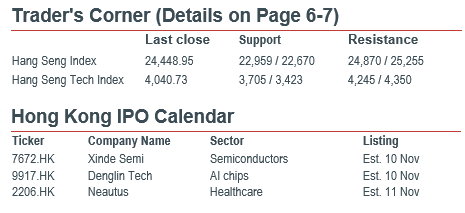
Traders' Corner
Our Technical View
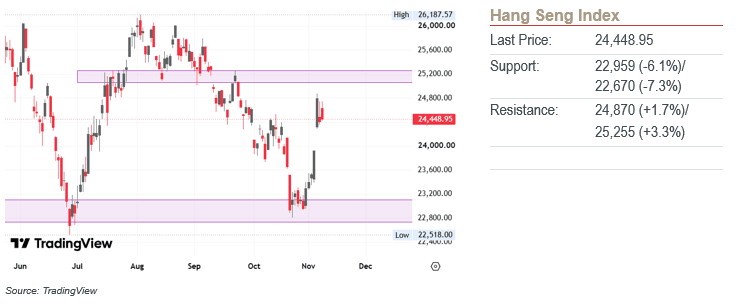
Weekly Chart: Price was rejected at its prior swing high resistance zone. The weekly RSI remains firmly anchored in bearish territory and is ticking downward with negative velocity. As long as price remains capped beneath the established resistance floor, we see continued downward expansion toward lower support zone.
Daily Chart: Price consolidated following a mark-up gap-up impulse, with price remaining completely contained within the body of the initial breakout candle for two consecutive sessions. The RSI remains firmly in bullish territory and is sloping upward with positive velocity. As long as price defends the gap-support threshold on transient intraday pullbacks, path-of-least-resistance dynamics heavily favor an upward expansion wave targeting overhead swing high resistance boundaries; conversely, a decisive closing breakdown below the gap baseline would invalidate the bullish structure, shifting polarity toward lower support zones.
Our Technical View
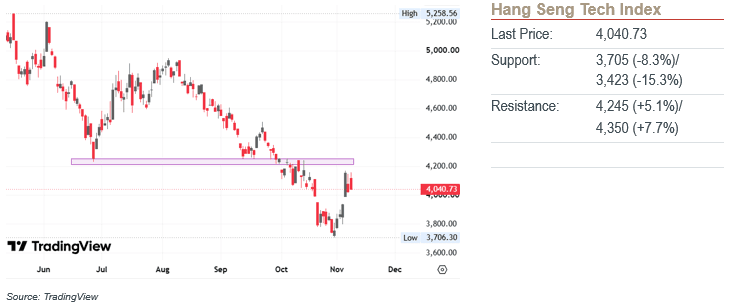
Weekly Chart: Price was rejected at its weekly support-turned-resistance baseline. Price reinforces an overarching mark-down regime characterized by a sequence of lower highs and lower lows. The weekly RSI remains anchored in strong bearish territory and continues to slope downward with negative velocity. In the absence of a confirmed bullish reversal structure, as long as price remains capped beneath the converted resistance baseline, we see continued downward expansion toward lower support.
Daily Chart: Price contained within the body bounds of the initial gap-up impulse candle for two consecutive sessions. However, this multi-day consolidation is directly constrained beneath an overhead swing high resistance zone. While the RSI has turmed bullish and crossed slightly above the 50 neutral baseline, the overhead supply ceiling presents an immediate structural barrier. In this market structure configuration, as long as the overhead resistance baseline holds firm, we see downside rejection wave back toward lower support
Market Movers: The S&P 500 rose 2.3% and Nasdaq 2.7%, with all 11 S&P sectors advancing. Nvidia (NVDA US) fell 4.3% after its board launched an independent investigation into a reported foreign-intelligence effort targeting its chief executive; directors said they had no reason to believe company secrets were compromised. AMD (AMD US) gained 13.3% following an analyst upgrade. Alphabet (GOOGL US) introduced two TPU systems, expanding its AI infrastructure offering. Japan Tobacco (2914 JP) slumped 16.0% after all seven Russian entities came under temporary administration. Russia represents about 25.0% of its FY26 adjusted operating-profit forecast. (eOption / Nvidia / Google / Company / Market data) Nvidia (NVDA US) and Alphabet (GOOGL US) are our Core Recommendations.
Macro: The New York Fed’s survey left one-year inflation expectations at 3.9%. The perceived chance of rising unemployment reached 45.3%, the highest since April 2020, indicating household caution. (New York Fed)
Geopolitical: China extended its suspension of an additional 24% tariff on US goods for two months from 13:01 SGT today, retaining the 10% levy. Possible replacement US tariffs leave the broader framework uncertain. (Ministry of Finance)
FICC: Brent settled 5.85% lower at US$92.57/bbl and WTI fell 4.38% to US$86.85/bbl as President Trump signalled restraint on Iran if talks progress. Shipping disruptions persist and no agreement was confirmed. Gold gained 0.97% to US$4,114.50/oz. (eOption / Reuters)
AI
• AMD gains as cloud adoption reinforces its AI position. Advanced Micro Devices (AMD US) rallied 13.3% as Oppenheimer upgraded the shares to Outperform with a US$600 target. The broker forecast 135% data-centre revenue growth in 2027. Google also selected EPYC host processors for its new TPU 8tx system. The combination supports a wider AI revenue opportunity, although the earnings assumptions remain forecasts and execution must justify the stronger valuation. (Investing.com / Company / Market data)
• Google broadens its alternatives to GPU infrastructure. Alphabet (GOOGL US) introduced TPU 8tx and 8i Max systems. The 8tx uses AMD EPYC host processors and adds protection for data and model weights in use; 8i Max combines two inference chips in one package, doubling compute, on-chip memory and memory bandwidth. These extensions give cloud customers more options for balancing AI performance, security and deployment cost. (Company) Alphabet (GOOGL US) is our Core Recommendation.
• Microsoft’s supplier review increases pressure on neoclouds. Microsoft (MSFT US) is evaluating a smaller group of specialist cloud suppliers while expanding its own data centres, CNBC reported, citing people familiar with the matter. No decisions had been made on which neocloud partners to drop. The company has worked with six such providers. Greater selectivity raises customer-concentration and funding risks for smaller operators without establishing a collapse in AI demand. (CNBC) Microsoft (MSFT US) is our Investment Opportunity.
• Anthropic increases model speed while widening access. Anthropic launched Claude Fable 5.2 and Mythos 5.2, reporting up to 30% faster performance than their predecessors. Standard API pricing is US$8 per million input tokens and US$40 per million output tokens. Fable is broadly available, while Mythos requires specialist verification. The release intensifies competition over AI capability, operating cost and access to sensitive functionality. (Company)
Americas
• Broadcom rebounds as cloud-software adoption expands. Broadcom (AVGO US) gained 8.8% alongside the wider recovery in AI infrastructure shares. Separately, its VMAPI project entered the Cloud Native Computing Foundation’s Sandbox, enabling virtual-machine management through Kubernetes, while VMware announced 20 new validated partners. The initiative may strengthen VMware’s relevance across mixed cloud environments, although the broad share-price rebound cannot be attributed solely to this software announcement. (Company / Benzinga / Market data) Broadcom (AVGO US) is our Core Recommendation.
• FDA labelling action adds scrutiny to obesity treatments. The FDA required all GLP-1 receptor-agonist manufacturers to add warnings about a potential increased risk of NAION, a rare eye condition that can cause permanent vision loss. The class-wide action is relevant to Lilly’s diabetes and obesity franchise. It raises monitoring and disclosure obligations, while the notice does not quantify a resulting commercial impact or establish a sales forecast. (FDA) Eli Lilly (LLY US) is our Core Recommendation.
• Berkshire increases buybacks despite softer insurance earnings. Berkshire Hathaway (BRK.B US) repurchased US$9.6bn of shares during the third quarter, bringing nine-month purchases to US$14.4bn. Operating earnings declined 5.8% YoY to US$12.7bn, with insurance underwriting profit down 42.9%. Capital returns provide support, but the weaker underwriting result shows that the conglomerate’s defensive appeal still depends on pricing discipline and insurance-loss trends. (Company / Market data) Berkshire Hathaway (BRK.B US) is our Core Recommendation.
• Constellation earnings strengthen the power-demand case. Constellation Energy (CEG US) rose 10.5% after third-quarter adjusted operating EPS reached US$5.06, up 66.4% YoY from US$3.04, including the contribution of acquired Calpine. Management raised the midpoint and narrowed full-year guidance to US$12.50–12.80. The stronger outlook supports the investment case for scarce generation capacity, although acquisition effects mean the reported earnings growth should not be read as purely organic. (Company / Market data)
• NRG recycles generation assets into buybacks and debt reduction. NRG Energy (NRG US) rose 10.3% after announcing a US$4bn sale of six gas-generation assets to LS Power, representing 4.9GW of capacity. The price implies eight times projected 2027 adjusted EBITDA. Proceeds support additional repurchases and debt reduction, improving capital flexibility; however, the transaction remains subject to regulatory approval and is targeted to close in the second quarter of 2027. (Company / Market data)
• Occidental debt reduction improves capital-return capacity. Occidental Petroleum (OXY US) reported US$2.8bn of quarterly free cash flow before working capital from continuing operations and reduced principal debt to US$10bn. Production averaged 1.427m barrels of oil equivalent daily, down 2.6% YoY. The stronger balance sheet increases flexibility for shareholder returns, but lower output and sensitivity to realised oil prices remain relevant to the sustainability of cash generation. (Company / Company) Occidental Petroleum (OXY US) is our Core Recommendation.
• Household job concerns rise despite steady inflation expectations. The New York Fed’s October survey left one-year inflation expectations at 3.9%, but the perceived probability of higher unemployment rose 1.4 percentage points to 45.3%, its highest since April 2020. Expected missed debt payments rose to 13.8%. The divergence suggests household caution can persist despite resilient hiring, keeping consumer credit and discretionary spending under scrutiny. (New York Fed / Reuters)
• KKR fee and realisation income lifts quarterly earnings. KKR & Co (KKR US) reported adjusted net income rose 29% YoY to about US$1.6bn, or US$1.78 a share, as asset sales and fees strengthened. Fee-related earnings increased 27% to US$1.3bn, with assets under management exceeding US$800bn. The results show the benefit of recurring fees alongside investment exits, while continued distributions depend on receptive financing and acquisition markets. (Company / Reuters)
• Surgery Partners prioritises deal certainty over a higher rival bid. Surgery Partners (SGRY US) agreed revised HealthSpan terms providing US$25 cash per share plus potential ticking fees, valuing the transaction at up to US$6bn. Its board preferred that agreement despite a non-binding US$28 rival proposal, citing execution and regulatory concerns. The difference highlights why headline takeover prices must be weighed against financing, approval risk and the probability of completion. (Company)
Greater China
• TSMC reiterates its logic-foundry focus. Taiwan Semiconductor Manufacturing (TSM US) told Tom’s Hardware it remains focused on its dedicated logic-foundry business, responding to a report that it was exploring 3D DRAM production. The clarification was published on 7 November. It leaves any direct entry into memory manufacturing unconfirmed, tempering speculation about a new competitor to established memory suppliers and a substantial change in its investment strategy. (Tom’s Hardware) Taiwan Semiconductor Manufacturing (TSM US) is our Core Recommendation.
• Meituan opens its multimodal model to developers. Meituan (3690 HK) made LongCat-2.5 weights available under an MIT licence, broadening access beyond its earlier API launch. The model has 1.6tn total parameters, with about 48bn activated per token, and targets visual and coding tasks on domestic AI accelerators. Wider developer adoption could strengthen its AI ecosystem, although published benchmark results remain company-reported. (Meituan / AICoder) Meituan (3690 HK) is our Investment Opportunity.
Asia ex. China
• Japan Tobacco faces wider Russia exposure. Japan Tobacco (2914 JP) fell 16.0% to JPY5,269 after confirming all seven Russian entities were under temporary administration. Russia represents about 10% of forecast annual revenue and 25% of adjusted operating profit; September-end assets total JPY1.5tn. Operations continue, but the company is assessing the earnings impact, leaving substantial uncertainty over control and recoverability. (Japan Tobacco / Market data)
• Mitsui Chemicals takes a major semiconductor step. Mitsui Chemicals (4183 JP) fell 8.5% to JPY1,586 after agreeing to acquire JSR for JPY1.84tn including debt. Funding includes a JPY1.64tn bridge loan and JPY200bn from Development Bank of Japan, with up to JPY150bn of common equity contemplated. The deal expands semiconductor-materials exposure, while planned refinancing creates dilution and balance-sheet risks. (Mitsui Chemicals / Market data)
• OCBC banking strength offsets insurance volatility. OCBC (O39 SP) 6 November release showed third-quarter net profit rising 3% YoY to S$2.04bn, although it fell 8% sequentially as insurance investment performance weakened. Net interest income increased 4% YoY to S$2.31bn, while nine-month wealth fees rose 25% YoY. A 0.8% non-performing-loan ratio supports earnings resilience, but investment-market swings remain a source of volatility. (OCBC)
EMEA and Others
• UniCredit lifts its earnings outlook. UniCredit (UCG IM) rose 6.3% to EUR81.62 as third-quarter net profit increased 24% YoY to EUR3.3bn, exceeding analysts’ EUR2.8bn estimate. Revenue grew 12% YoY and costs declined. Management now expects annual profit before extraordinary charges well above EUR11.5bn, strengthening the earnings base as it prepares further steps toward control of Commerzbank (CBK GY). (Reuters / Market data)
• Banco BPM surges on proposed Italian banking combination. Banco BPM (BAMI IM) gained 10.70% to EUR14.88 after Crédit Agricole (ACA FP) proposed merging its Italian bank into the lender. The proposal includes a EUR1bn extraordinary dividend and estimated annual pretax synergies of EUR800mn, creating Italy’s third-largest banking group. Completion is targeted for the second half of 2027, subject to shareholder and regulatory approvals. (Crédit Agricole / Reuters / Market data)
• Argenx expands into peptide medicines. Argenx (ARGX BB) agreed to acquire Unnatural Products for US$550mn upfront and up to US$595mn in development and regulatory milestones. The platform complements its antibody expertise and could support oral or long-acting treatments for immune diseases. Closing is expected by year-end; the contingent structure links much of the potential US$1.15bn cost to future progress. (argenx)
Traders' Corner
Our Technical View
Weekly Chart: Price was rejected at its prior swing high resistance zone. The weekly RSI remains firmly anchored in bearish territory and is ticking downward with negative velocity. As long as price remains capped beneath the established resistance floor, we see continued downward expansion toward lower support zone.
Daily Chart: Price consolidated following a mark-up gap-up impulse, with price remaining completely contained within the body of the initial breakout candle for two consecutive sessions. The RSI remains firmly in bullish territory and is sloping upward with positive velocity. As long as price defends the gap-support threshold on transient intraday pullbacks, path-of-least-resistance dynamics heavily favor an upward expansion wave targeting overhead swing high resistance boundaries; conversely, a decisive closing breakdown below the gap baseline would invalidate the bullish structure, shifting polarity toward lower support zones.
Our Technical View
Weekly Chart: Price was rejected at its weekly support-turned-resistance baseline. Price reinforces an overarching mark-down regime characterized by a sequence of lower highs and lower lows. The weekly RSI remains anchored in strong bearish territory and continues to slope downward with negative velocity. In the absence of a confirmed bullish reversal structure, as long as price remains capped beneath the converted resistance baseline, we see continued downward expansion toward lower support.
Daily Chart: Price contained within the body bounds of the initial gap-up impulse candle for two consecutive sessions. However, this multi-day consolidation is directly constrained beneath an overhead swing high resistance zone. While the RSI has turmed bullish and crossed slightly above the 50 neutral baseline, the overhead supply ceiling presents an immediate structural barrier. In this market structure configuration, as long as the overhead resistance baseline holds firm, we see downside rejection wave back toward lower support
Disclosures and disclaimers
This report is provided subject to, and must be read together with, the full Disclosures / Disclaimers available at this link, which are incorporated by reference into this report. In particular, this report is intended for general circulation and informational purposes only and does not constitute personal investment advice or a recommendation to buy or sell any investment product or security. You should independently evaluate the information and, where necessary, seek advice from a qualified financial adviser regarding the suitability of any investment. Analyst certifications required under applicable regulations, including SEC Regulation AC (where relevant), are included in this report. By accessing, receiving or using this report, you acknowledge that you have read, understood and agreed to be bound by the Disclosures / Disclaimers, as may be amended, supplemented or updated from time to time.


